
Three doctors, three cities, one losing argument with the internet.
It is six thirty on a Wednesday evening and I am number four in the queue at Doctor V’s clinic. I have a work call at seven thirty. The clinic is a ten-minute walk from my house. I have done the maths, because this is what illness does to you eventually. It turns you into a project manager of your own inconvenience. Queue position, commute time, likely duration of consultation, payment delay, margin of error. If Doctor V is in form, I will be home by seven fifteen.
Doctor V is usually in form. Doctor V does not waste time.
The nurse has already taken my vitals on her tablet. Blood pressure, blood oxygen, weight, BMI. My height, again, because the checklist demands it, even though I am in my forties and unlikely to have grown since my last visit three weeks ago. She asks if I have had a fever, if I have travelled, if I have any specific complaints. She types as I speak and uploads everything to the cloud. By the time I knock on Doctor V’s door, he has already read me.
Or at least, he has read my numbers.
He has also, I suspect, half-written my prescription. The metformin will be there. The supplement will be there, rotating monthly through the greatest hits of middle-aged womanhood: Vitamin D, B12, magnesium, the occasional iron tablet introduced like a visiting dignitary. The instruction to lose five kilos will be there. The instruction to hit my protein goals will be there. The goals do not change, and neither do I.
I have dressed for this appointment. By which I mean I picked that one outfit from the back of my wardrobe, the one that says I am a woman who moisturises her elbows and has not entirely abandoned civilisation. I have also applied approximately sixteen skincare and make-up products to my face. And no, I do not have a crush on my doctor. I simply believe that a visit to a doctor is one of the rare occasions on which I leave the house these days, and one ought to try.
Doctor V does not look up.
“Everything okay?” he says, typing.
I sit down. I have a plan today. For weeks I have been thinking about it, rehearsing it in the shower, in bed, while eating a protein-forward breakfast that filled me with resentment. Today I am going to do the thing forty-something women are now allowed, even encouraged, to do. I am going to advocate for myself.
“Doctor,” I say, “I had a question. I was wondering if I might be a candidate for a GLP-1. I was asking ChatGPT and…”
He looks up.
For the first time in five years, Doctor V looks at me.
His eyes, it turns out, are a light shade of brown. I had assumed this from the bits of him I could see around the edges of his laptop, but I had never properly confirmed it until now. There he is. Alive. Present. Furious in the patient, exhausted way of a man who has had this exact conversation forty times this week with forty other women who have arrived armed with the confidence of a monthly subscription.
“You know your history better than I do,” he says. “Given your history, this is not something I would casually put you on.”
I nod, trying to look like the kind of woman who knows her history and not the kind of woman who has spent the previous week asking an artificial intelligence model increasingly deranged questions about pancreatic safety.
“My suggestion,” he says.
“Yes?” I say, waiting for what I believe may be our first truly human moment in an otherwise ethernet-based relationship.
“Firstly, get off the internet. Get off the internet. For God’s sake, get off the internet.”
Then, because Doctor V is a reasonable man and knows the war is already lost, he adds, “For medical advice.”
He says something else about protein, but I have already drifted away. I scan a QR code, pay, and leave with my prescription. It is a strange little miracle: I have had a full medical appointment with almost no evidence that my body was in the room.
I am not even complaining. Doctor V is efficient, up to date, and not unkind. His clinic runs beautifully. There is no waiting for files to be found, no nurse yelling names into a corridor, no ancient blood pressure machine wheezing like a retired uncle. Everything is clean, uploaded, synced, and billed. Still, as I walk home, prescription in hand, I find myself thinking of the other doctors who have had the misfortune of becoming characters in my life.
Doctor V is the third recurring doctor of my adult life. Before him, there was Doctor S in Bombay, until COVID, when I chose to flee the city. And before Doctor S, there was Doctor K in Chennai, who saw me through my teens and early twenties and knew far more about me than was strictly necessary.
Three cities. Three life stages. Three men trying, in their own ways, to decide what was wrong with me.
Doctor S entered my life the way many people enter your life in Bombay: through a combination of desperation, geography, and online reviews. I had moved cities. I needed a doctor. I needed someone near my house or near my office, because in Bombay “slightly far” is a philosophical category involving sweat, traffic, and the possibility of never returning.
Friends recommended celebrity doctors who treated Bollywood people and had no time for peasants like me, or beloved local doctors who lived six suburbs away in what may as well have been another country. In the end, I went online. Doctor S had good reviews on one of those aggregator apps. He was an endocrinologist who also did general medicine, which meant he could treat both me and my mother. He had a clinic near my house and a hospital near my office. He fit.
For our first appointment, he ordered three hundred and sixty-seven tests. Possibly fewer, but it felt like three hundred and sixty-seven. Blood work, scans, and a urine sample whose specific gravity was apparently vital information. I do not know what the specific gravity of urine tells anyone about anything, and I suspect Doctor S did not entirely know either, but it was a number, and Doctor S liked numbers.
The reports came back that evening with many things underlined. The big things were fine; the small things were not. This, I would learn, was Doctor S’s preferred medical genre: nothing alarming, everything improvable.
He was young, close to my age, modern, and very quiet. I am largely a quiet person too, so it was a terrible combination. We sat in his consulting room, two introverts separated by a desk and a stack of diagnostic reports, each waiting for the other to become the kind of person who says things.
Doctor S came alive only when talking metrics. If I asked him how I was doing, he would shrug. If I asked him about my HbA1c, he would lean forward. He did not want me healthy; he wanted me at five point four. He wanted my triglycerides, my Vitamin D, my fasting insulin, and my urine specific gravity at the exact textbook numbers. He wanted me to be the woman in the textbook.
I spent five years with Doctor S. At the end of those years, I was probably the healthiest I had ever been on paper and the most miserable, because something was always slightly off. There was always one parameter underlined. There was always a number that had not behaved. The job of being his patient was full-time and came with no leave policy.
In retrospect, Doctor S was my cool cousin. The one who has read more than you, knows more than you, and is not angry with you exactly, just disappointed by your sample size. To him, I was a project. The project was optimisation. The project was never going to be done.
I am no longer in touch with Doctor S, but I am reasonably certain he is currently somewhere running regression analyses on GLP-1 outcome data and feeling privately vindicated.
Doctor K was already old when I started going to him. Based in Chennai, he was an endocrinologist by training but a general physician in practice, which in those days meant he was your first stop for everything. My grandmother went to him. My parents went to him. I went to him. Knee pain, gynae issues, geriatric issues, mysterious teenage exhaustion, the vague sense that one’s life had gone wrong, all of it shared the same waiting room.
His clinic smelled of rubbing alcohol and incense. This is not a metaphor. He believed in modern medicine, but he also believed in alternative therapies, journaling, prayer, art projects, the power of the mind, and faith. The only thing he drew the line at was homeopathy, which he dismissed as outright quackery. Beyond that, anything was possible. Ayurveda, supplements, meditation, some American thing someone had mailed him a brochure about. Doctor S would have developed a rash in his presence.
Doctor K spent forty-five minutes to an hour with each patient, sometimes more. This meant that even if I was number four or five in the queue, I would wait two hours to see him, arriving in the room already filled with the spiritual calm of a young woman who wanted to murder everyone.
I was twenty-two. I had PCOS, which had not yet been named PCOS in our house, and I was overweight, which had been named everything, by everyone, since I was eleven. My mother brought me to Doctor K because other doctors had given up and decided I was wilfully refusing to lose weight, as if thinness was an invitation I had rudely declined.
My mother and Doctor K had a working understanding that any conversation about my health needed to begin with the foundational question: how do we solve a problem like Radhika?
I resented this deeply. I still do, slightly. It is one thing to be a problem. It is another thing to be a musical.
When I walked in, Doctor K did not look at the chart. He looked at me.
“Tell me,” he said. “What is happening?”
Not what is hurting. Not how long. Not how heavy is the flow. What is happening.
What was happening, in his view, was my life. My opinions, which he found amusing. My faintly socialist tendencies, which he found less amusing. The boy situation, the neighbour situation, the outwardly-supports-the-opposing-cricket-team-but-secretly-cries-when-Rahul-Dravid-gets-out situation. He wanted all of it. Then he wanted my mother. He would talk to her for just as long, believing her state of mind had a direct bearing on mine, which it did, though I was young and deeply offended by the suggestion.
Eventually, the examination would begin. He would ask me to take off my glasses and look him in the eye. He would press two fingers, his index and middle, to the side of my neck. To this day, I do not fully know what he was checking. Lymph nodes? Carotid pulse? The presence of original sin? He never explained. Then he would ask me to open my mouth and say aah. He would pull down my lower eyelid and study it for evidence of health or its absence. Finally, he would place his thumb on my wrist, look at his watch, and count for sixty seconds. The oximeter was either not yet invented or out of his price range, and his thumb was perfectly adequate.
After the hour of conversation and the ritual examination, he would prescribe. Metformin, yes. A diuretic, so I could pee out the water weight. And then the actual prescription, the one he believed mattered most.
Journal. Art. Pray. Focus on trigonometry. Be happy. Choose differently.
I hated this part.
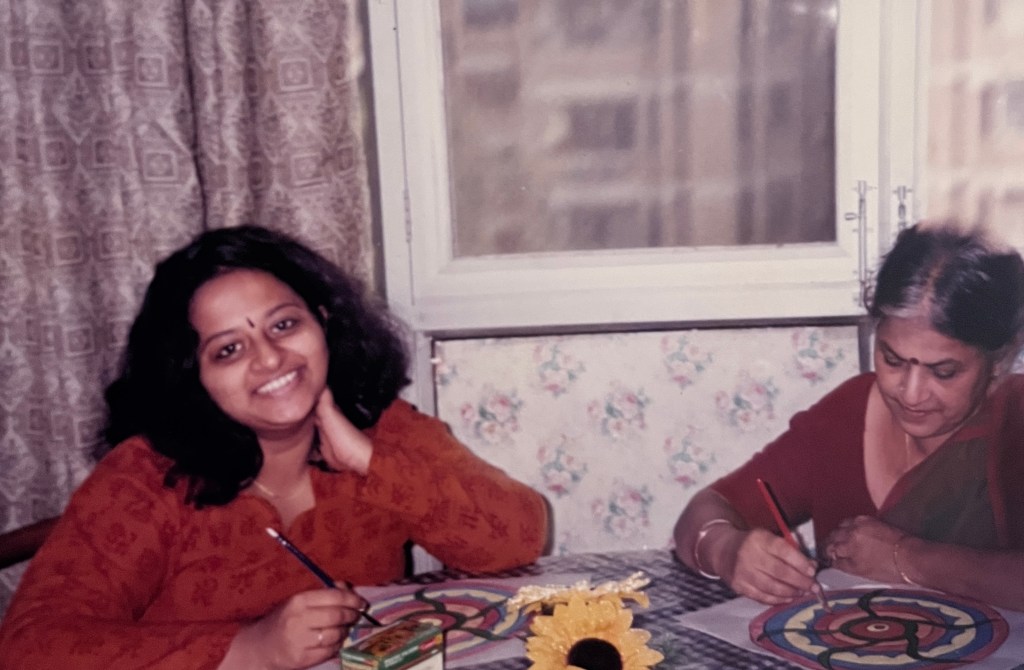
He once suggested art therapy. My mother joined in, which was her way of ensuring I did not feel observed, improved, or medically managed. I still felt all three, obviously, but I also felt loved.I had come for a pill. I wanted the problem to be entirely in my hormones, where he could fix it, not in my mind, where the responsibility was somehow mine. I wanted a medical explanation clean enough to absolve me. I wanted to be a case, not a person. A case could be treated. A person had to change.
So I left every appointment annoyed. Doctor K had once again failed to understand that I was not interested in becoming the best version of myself. I was interested in becoming thin while remaining emotionally identical.
It has taken me twenty years to understand that he was right. Or at least, that he was onto something.
Doctor K saw me as Radhika: twenty-two, furious, funny, full of opinions and contradictions, with a mother, a future, a body, and a life all tangled together in ways that could not be separated on a blood report. He did not always get it right. He was paternalistic. He moralised. He was, of course, a father figure, which is to say he was both comforting and impossible. Doctors in our culture are gods, and he was a particularly godly one. I never told him I disagreed. I just rolled my eyes on the way out and then did some of what he said.
I went looking for him recently. I had the GLP-1 question, but really I had another question underneath it. A more embarrassing one. I wanted to know what he would have made of me now.
Would he have laughed? Would he have said, “This is not your solution”? Would he have asked what was happening and waited long enough for the real answer? Would he have looked at my blood work and then past it, into the mess of work calls, ageing, vanity, fear, ambition, exhaustion, and the strange humiliation of still wanting, in middle age, to be transformed?
I looked him up.
He died in 2021, during COVID, a year after my mother
If Doctor K were alive today, he would not be in his old clinic in Chennai with the incense, the rubbing alcohol, and the hour-long appointments. He would have been claimed by the age. He would have had an Instagram account, a podcast, a protein powder line, a book, perhaps a wellness retreat in Coorg where urban people paid a great deal of money to journal and be told to sleep earlier. He would have told people to pray, meditate, check their thyroid, and focus on trigonometry. He would have had legions of adoring fans and an assistant managing his reel schedule.
Even Doctor K, the most human of them, would not have escaped.
Doctor S has become the data. Doctor V runs from the cloud. Doctor K would have become content. And I, who claim to miss being seen as a whole person, arrived at Doctor V’s clinic with my face done, my symptoms organised, my question pre-validated by ChatGPT, ready to present myself as efficiently as possible.
This is the part I do not like admitting. I want the old intimacy, but I also want the new convenience. I want the doctor to look at me, but not for too long. I want him to understand my history, but I also want him to hurry up because I have a work call. I want to be treated as a person, but only if it does not involve being asked what is actually happening.
Doctor V, the most algorithmic of the three doctors, is now the only one left telling me to get off the internet.
And he knows it is hopeless. That is why he qualifies it.
For medical advice.
He is holding a line he knows he cannot defend.
I came home from that appointment three days ago. I made my work call. I ate something with protein in it. Then I sat for a long time, thinking about Doctor K, about his thumb on my wrist, about the way he used to ask what was happening as if the answer mattered.
I wanted so badly to ask him what he would have done.
Instead, I opened ChatGPT.

 Primalsoup
Leave a comment