
I did not attend Renu’s wedding.
This was in 2007, when we were colleagues and friends. Not best friends exactly, but the kind of office friends forged under mild but sustained adversity. We would call it trauma bonding today. At the time, we called it getting each other’s jokes. Over the years, the friendship deepened in the way many adult friendships do: through intermittent phone calls, forwarded memes, and the comforting knowledge that the other person will immediately understand why something is funny.
Renu was getting married in Bombay, and I had been seconded to the Bombay office for a month because everyone else was on leave or pregnant or both. I was staying at the Dadar Catering College, which was not fancy but was affordable and close enough to the office for a person living on per diem.
I checked out on the morning of the wedding. I had a suitcase, a laptop bag, and a handbag. I walked through Dadar Market toward Shivaji Park, where a Jai Bhim gathering had filled the streets with people, blue flags, police barricades, and the particular Bombay feeling that something much larger than your personal inconvenience was already underway.
I waited a long time for a taxi. When one finally stopped, the boot was full. I set my suitcase on the passenger seat of the car and walked around to get in. Before I reached the other side, the taxi drove off with it.
I lived in Bombay for years. I had fallen asleep in kali peelis at one in the morning, trusting drivers I had never met to deliver me safely to the right gate. So I was not entirely certain that the man had stolen my suitcase. Perhaps he thought I had climbed into another cab. Perhaps he was confused. Perhaps Bombay, which has always had a small Raj Kapoor clause, had simply decided that I had arrived with too much luggage and too much faith in the city.
Either way, he and my suitcase disappeared.
I waited. Then I went to the police kiosk at Shivaji Park, where the constable stationed there for the bandobast looked at me as if I had announced the discovery of fire. He advised me to file an FIR.
I was already late for work. I had a focus group to moderate. So I found another taxi and went to the office.
From there, I called my mother.
My mother, who understands Bombay through a highly specific theological framework, said that Mahalakshmi had taken my suitcase.
To clarify, Mahalakshmi was not a famous Bombay bandit or a specialist in luggage crime. She was, in fact, the goddess.
I said that made no sense.
My mother said it made every sense.
In all the years I had lived in Bombay, I had never once gone to pay my respects at the Mahalakshmi Temple. The goddess had been patient, but her patience was not infinite. This was not theft. This was a lesson. The goddess had finally had enough.
I told my mother there was a wedding that evening and I had no clothes. I was wearing contact lenses with no case, had no glasses, and possessed no second pair of anything.
She told me to come home.
So I flew back to Chennai.
Renu and I were still in the early stages of what would become a long and entertaining friendship. She had invited me to one of the most important events of her life, and I had responded, from her point of view, by vanishing entirely.
She assumed, quite reasonably, that I had simply not turned up.
The wedding happened, life continued, and the unsent apology became one of those low-grade hums that runs beneath a long friendship, audible only to me.
What I have not told anyone, including Renu, is how often I think about the suitcase itself.
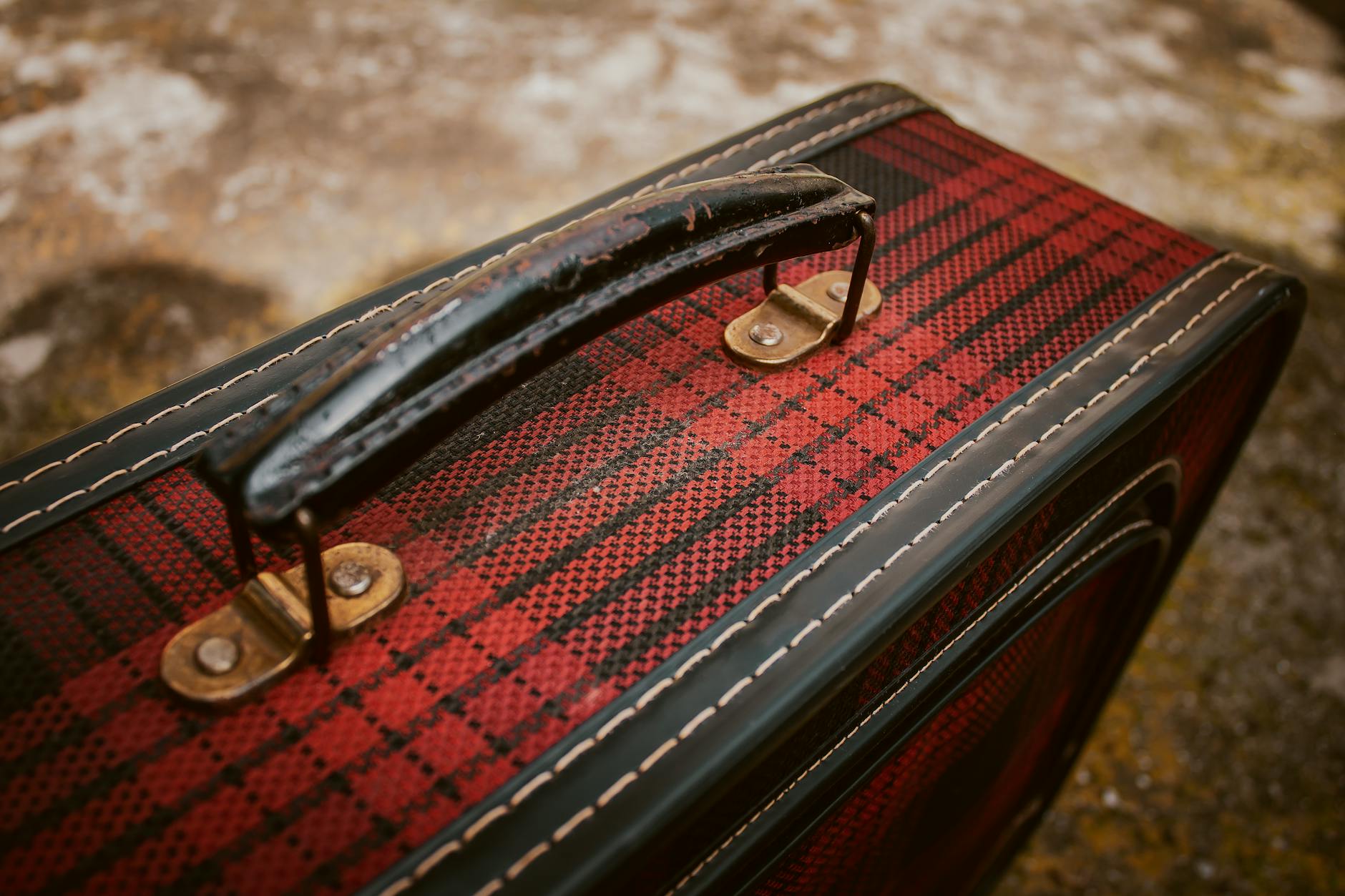
It was a fake Burberry, white and brown plaid, purchased in Sri Lanka. It came with a small vanity case that slid neatly onto the handle. Because I was not carrying the vanity case that day, I still have it.
It sits in my cupboard and has outlived its parent suitcase by eighteen years.
Sometimes, at an airport, I see someone with a real Burberry plaid, or a convincing fake, and think: there it is. The one that drove off without me.
Inside the suitcase were two wedding outfits, the only two wedding-appropriate outfits I owned at the time. One was a green-and-coral dress from Karol Bagh, bought by my mother during one of our trips. The other was a maroon blingy number, a designer knockoff in the general style of Manish Malhotra, which was close enough to couture for the weddings I attended.
Also packed was a brown Kalamkari dress I loved and wore constantly. Six pairs of underwear. Several bras. A month’s worth of clothes, half of them dirty. My contact lens case. My glasses.
And my nose rings.
I had recently had my nose pierced and, in the brief and optimistic period between piercing and theft, collected silver nose rings with coloured stones from different towns I passed through.
I lost them all in one taxi ride.
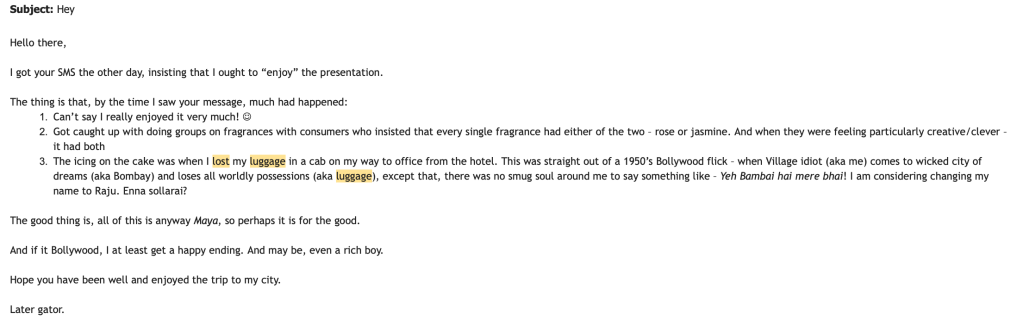
Exhibit A: Cringey mails that I wrote back then
Recently, I found an old email I had sent a colleague soon after. There I was, twenty-something and already narrating disaster as if it had been personally scripted for me by Hindi cinema. I had written that it was straight out of a 1950s Bollywood film: village idiot arrives in the wicked city of dreams and loses all worldly possessions, except there was no smug soul nearby to say, “Yeh Bambai hai mere bhai.”
I had even considered changing my name to Raju.
The good thing, I had written, was that all of this was Maya. Perhaps it was for the good. And if it was Bollywood, I would at least get a happy ending. Maybe even a rich boy.
Reader, I got neither the suitcase nor the rich boy.
But I did get the story.
This is what I mean when I say I think about the suitcase. Not the suitcase itself, but what it contained.
At the time, I mourned the clothes because I could not afford to replace them. Now, of course, I mourn them because I could never fit into them.
The brown Kalamkari dress and the woman who wore it. The body that believed clothes were permanent. The knees in old photographs that now surface unexpectedly in my gallery, smooth and unconsulted, belonging to someone who appears to have had no idea she was living in an era of excellent collagen.
That girl is gone.
Not because the suitcase took her. Time would have done that anyway. The suitcase simply got there first.
In the same old email exchange, my colleague wrote back saying she had heard about the baggage and thought it was “pretty cool” that I had not complained because I said it was meant to go.
This is alarming evidence that I have always been like this.
Even at twenty-something, even with no glasses, no wedding clothes, and no clean underwear, some part of me had apparently decided that the suitcase had not been stolen. It had been released from service. It had fulfilled its karmic duty and exited stage left.
I am not saying Mahalakshmi took my suitcase. I am also not saying she didn’t. I am only saying that since then, I have kept a spare contact lens case in every handbag. A spare pair of glasses. I never pack the irreplaceable item in checked luggage.
I travel as if a kali peeli may pull away at any moment with the boot full.
This is the kind of wisdom Bombay gives you. Not enlightenment exactly. More like operational paranoia with devotional undertones.
Every time I return to Mumbai, I think I should visit the Mahalakshmi Temple. I am not religious. My relationship with faith is complicated. But the goddess was upset with me once, and I do not wish to test her again.
Last week, in a WhatsApp chat, I mentioned the suitcase story to Renu for the first time.
She asked how she had never heard any of this.
I told her she owed me a wedding in the larger cosmic accounting.
She is not the only one. Alka, another friend from the same office, owes me a wedding too. She forgot to invite me to hers.
I am keeping a list.
Renu, to her credit, did not dispute the debt. She asked how soon I could come to Hyderabad.
This is why Renu and I are still friends. She understands debt, timing, and jokes that have taken nearly two decades to mature.
She does owe me a wedding.
The interest on it is this essay.


Leave a Reply