
This morning the song came up on shuffle while I was in the middle of my chores. I have a playlist I’ve built meticulously over the last decade, called ‘productivity’. Yet productive I am not, but that is for another essay. Suffice to say, it was a song I did not choose it in that moment. But there it was, transporting me back to India circa 2001 and 2002, the anthem of the youth then, which I used to be (shocking!). Koi kahe kehta rahe… hum hain naye, andaaz kyun ho purana.
Nobody else was home. I abandoned my chores and put the video on YouTube, and there they were, the three boys on the dance floor in shiny leather pants, dancing away because of their absurdly uncomplicated nepo baby lives. Even the introvert of the group was out there.
So I joined them. I danced to all five minutes and twenty-five seconds of it.
Badly in places. Very badly in places. But also, not badly in others.
Now dancing and movement are supposed to release endorphins and be good for my well-being, as per my therapist (by which I mean a random person on my For You page that my Instagram algorithm kindly sends my way). But I was just out of breath, and collapsed on the floor in front of my TV. And as I tried to catch my breath, I informed the empty room, with the seriousness of a woman making a resolution she has made before, that I was never going to dance again.
I will, obviously, dance again. The next time the song surfaces, I will force every wisp of hair into submission with a top knot, and do exactly this.
The vow is part of the choreography.
Dil Chahta Hai turned twenty-five this month, and every younger Gen Xer and older Millennial has been reminiscing about how the movie had us all in a chokehold. There are many thoughtful essays about how it changed Hindi cinema, how it invented a grammar of urban friendship, how the styling and the restraint arrived like weather. All of that is true and I have nothing to add to it.
Okay, I have one thing to add. The movie was a cultural reset moment for me personally, and a Midday interview with Adhuna Akhtar (now Bhabani), who styled the actors, made me seek out her salon Juice, then in South Bombay. I got my very first overpriced haircut there, and it was worth it. My friend and I ate masala dosa at a famous street vendor outside Nana Nani park afterwards, because there was no money left. Oh, to be young and to decide what is more important, a haircut or rent. Truly a Sophie’s Choice.
However, this essay is not about me trying to turn into Preity Zinta. What I keep returning to is something much smaller. How the movie came out the very year I started working, and for a few months that year, and the following few years, the song was less a song than an instruction.
To explain why I was sitting down while it played, I had to go and open some binders.
My parents might never have said this to me in actual words, but they were very proud of me, as is evidenced by how they meticulously preserved the many certificates and medallions I have to my name since kindergarten. Every certificate from my convent school days in Kolkata, my Air Force School days in Delhi, and the multiple Kendriya Vidyalayas I studied in between them, as we uprooted our lives mid-year because of Appa’s job. Shivaji House, Ashoka House, Clarence House, Manekshaw House, Tagore House, Blue House, all venerable institutions I represented through the years.
English recitation. English elocution. Hindi recitation. Hindi elocution. Hindi debate. Storytelling. Solo music. Quiz. Often placed third, many times second and at times even first, all of them preserved inside a binder with plastic sheets. My favorite are the ‘consolation’ prize certificates, and in even more competitive years, the ‘participation’ ones. Those have been retained too. Looking at the binder, I now realize my parents did think of me as a special snowflake, and here I was thinking I had generational trauma.
As someone who loves to look for patterns, I can instantly see that almost all the certificates are for speaking.
I entered every competition that had an entry form, and the form was nearly always for my voice. I would stand in front of the entire school and recite in a language that was not my mother tongue and win a piece of paper for it. I was not a shy child. There is documentary evidence, going back to the age of seven, that I was not remotely shy.
But recitation is a specific kind of public performance. You face the room, maintain eye contact with that one ‘best friend’ you have, and shut out the rest. Nothing crosses. You are looked at, and nothing is transmitted. I got very good, very young, at the form of public presence that keeps everybody precisely where they are.
In all of this, there is one dance certificate. Talents Day, Ashoka House, third position, class IV B. I was nine.
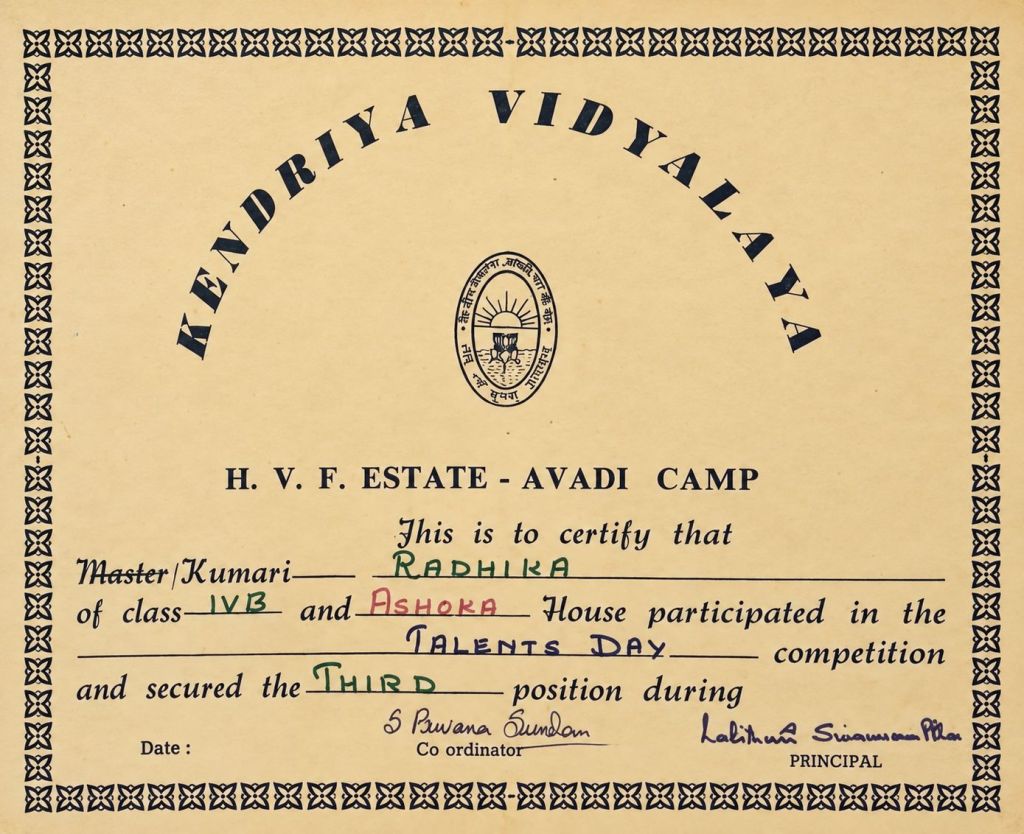
So, I was a dancer. This is State’s Exhibit A.
There were others, without the trail of cardstock and house allotments.
In Pune, when I was well into my teens, as was tradition in those times of sparse entertainment choices, our little colony held its annual talent show-cum-potluck-cum-start-of-winter shindig. (Though some might point out that Pune really does not have a winter. To them I say, you are wrong.)
This was the period when the Khans had burst onto the scene and captured the imagination of women of all ages. I was not immune to this, surprising myself. That year it was Maine Pyar Kiya, and it ate the year whole. The romance-musical-family-drama was not really a dance-y movie, but there was an elaborate Antakshari medley made up of old Bollywood numbers that became a thing. The premise was that our uber coy female lead refused to profess her love to our brawny brashy hero in front of her future mother-in-law and a gaggle of aunties.
So the children of the colony put up an elaborate production of this Antakshari number. Shockingly, I was cast as Bhagyashree, the female lead. I can only assume this happened because my father was the most senior officer in that little defence colony we lived in. Who knew, I was the original nepo baby.
So what she did on screen, I did off it, and one December I danced it in front of my colony aunties.
Anyone who has encountered a subcontinental aunty knows this is wildly brave behaviour. There is no more exacting audience anywhere on earth. Not a room of exam invigilators, or a bunch of clients with ready escalation emails. My judges were the far more formidable aunties. Aunties, sitting in the front row, with opinions, ready to reconsider my ranking in the great Indian pecking order of Sharmaji ki beti.
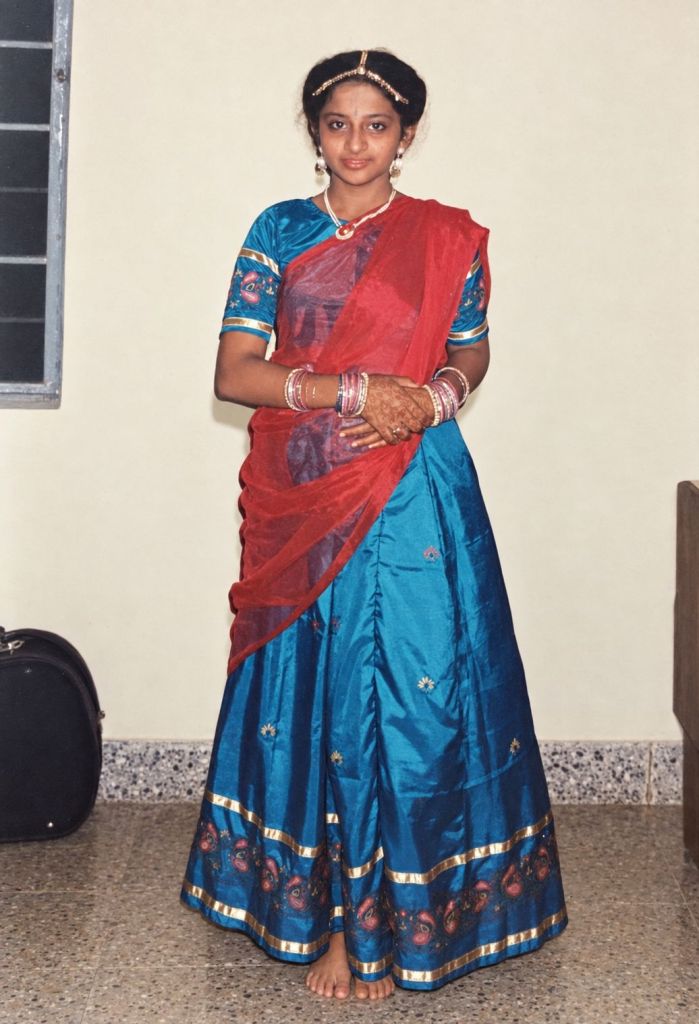
I did it anyway. There is a photograph. Blue-green lehenga, magenta dupatta pinned across, a mathapatti, mehendi, every bangle in the house. Amma came through and meticulously hand-embroidered and sewed my skirt over a record two weeks.
You may consider this State’s Exhibit B.
Also, before people who know current me are baffled that I played the very coy and sweet Bhagyashree, the same evening in our production of Mind Your Language I also played Ali Nadim, the boy from Pakistan. So after my blue silk lehenga, my next costume was a white chikankari kurta and a skullcap, helpfully loaned to me by Rahman Uncle.
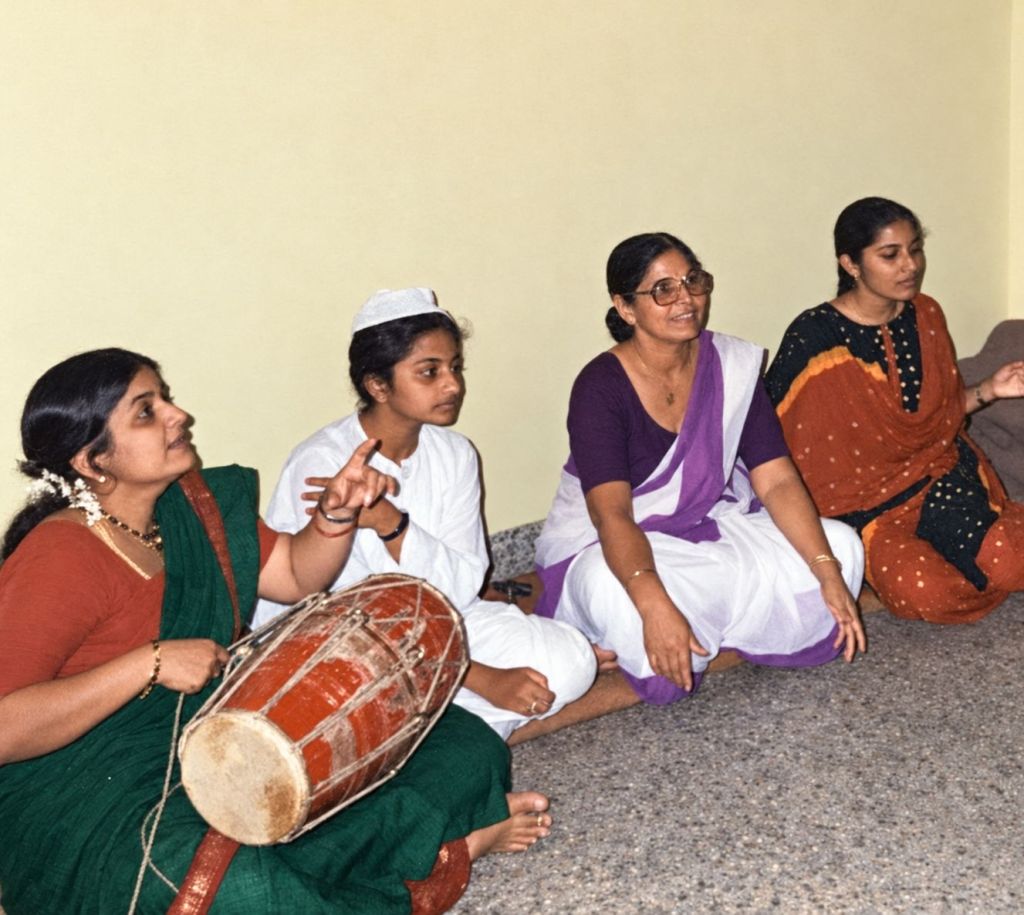
It was not a one-off. Over those colony years I also did Mere Haathon Mein Nau Nau Choodiyan Hain. And Humko Aaj Kal Hai Intezaar.
Which is to say: at fourteen, with no real training of any sort, I stood up in front of a residents’ association and did Sridevi. And then, another year, Madhuri. At this point my prefrontal cortex had not developed enough to know that this was possibly blasphemy.
By the time we moved to the city formerly known as Allahabad, my dancing status got a massive upgrade.
As the only South Indian girl in my school that year, with a four-syllable last name, it had been decided by those in the know that I was trained in Bharatanatyam. I was not. Not because Amma did not try to get me interested, I had done three months of classes and stopped, because I had decided I wanted Kathak instead. That I stopped in three weeks.
But the school had made its determination, and I was a confident child (a quality I credit and blame my parents for in roughly equal measure), so I went up on the stage. I did things with my hands, twisted my fingers as best I could, and made eyes. It was received as Bharatanatyam. I won.
I was not bluffing. Bluffing requires knowing. I believed, without a flicker of doubt, that what I was doing was Bharatanatyam, and the winning kept confirming it, and the confirmation kept the confidence topped up, and so it went on until I was invited to S Deepa’s arangetram.
S Deepa was the other Tamil girl in the city, so naturally Amma found her mother within weeks of us moving in (I mean, where else to find someone who can tell us the best place to rent the latest Rajini movie’s VHS tapes). As I sat through S Deepa’s performance, a lightbulb went off in my head: that is Bharatanatyam. What I do is not that. It is not even in the same neighbourhood.
That afternoon, Deepa and my mother took us to see Deewana, the third and final of the Khans’ debut features.
There was a boy in it who was in the process of becoming a bit of a person. I came home and danced to Aisi Deewangi in my room and did not think about Bharatanatyam again.
There was no full-length mirror in that house. There were no phone cameras. I simply assumed I was very good. After all, I was an untrained Bharatanatyam dancer with a certificate.
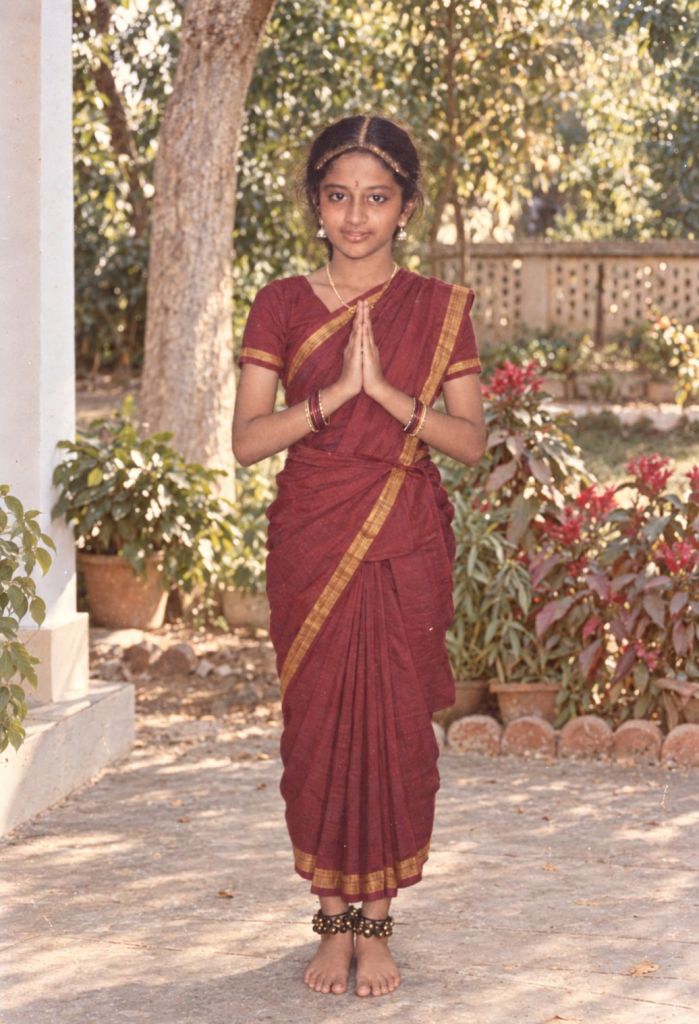
State’s Exhibit C.
By the time I was a young woman with a mostly well-developed prefrontal cortex, and had come to Ahmedabad with the great Indian middle-class dream of adding an MBA degree and selling cooking oil and bathing soaps, something had closed, and I can date it no more precisely than that.
Ahmedabad during Navratri is a vibe, and it does not permit neutrality on this subject. Garba and dandiya are not an event there; they are the weather. And I participated fully, by which I mean I assembled a costume. Bandhani, the correct jewellery, everything right down to the last detail. I have the photographs. I am in several of them, arms around my friends, beautifully turned out, at the edge of the ground.
I never once went in.
The first year, and for the first few ‘dance parties’, your friends and peers will try to include you. It is simultaneously touching and annoying. Here is what happens. A new set of people meets you, and for a while they keep coming back for you. Someone holds out a hand mid-song. A good-natured tug at your wrist. I wholly understand that none of this is ever malicious; rather, everyone assumes that you are standing at the edge because nobody has invited you, and that a warm invitation is what you are waiting for.
With time, everybody works out that this one is an immovable object, and that no irresistible force can move it, and your role is upgraded (or downgraded) to that of the custodian.
By the second hour of many of these evenings, I am holding things, or at any rate they are strewn around me. Heels. Bags. Water bottles. Car keys. Dupattas that turned out to be impractical. Jackets, because someone has worked up a sweat with all the dancing. Somebody’s spectacles. Cameras, in the years when there were cameras, and then everyone’s phone. And so the pile accumulates around me, for no rhyme or reason. The only logic is: Radhika is here, she is not moving (at least not until the buffet opens up), let’s leave our things around her. And they are not wrong. I will be there, because I am now holding all of it, feeling mild resentment build as I smell the butter naan and the spicy curries from the buffet that at some point is set up. And so poor Radhika, guarder of bags and shoes, cannot escape after all, trapped in a tiny circular wall of leather and fabric scraps.
It is not that adult me has avoided public spectacles of dance completely. I keep signing up. In my twenties I joined a Zumba class, because it combined two beloved things, Bollywood and my quest for weight loss. Three classes, that is all it took, and I was out. Why? Because in the very first class my instructor announced that for the first few weeks we would exercise and build our core strength. My core protested, and I listened to her. If I don’t listen to my core, who will?
Which brings me back to Dil Chahta Hai, and my very first company offsite.

The offsite was at Timber Trail, somewhere in the vicinity of Shimla. We were taken up to the resort in cable cars, which was equal parts terrifying and thrilling, a hundred-odd of us swaying over a gorge.
The days were packed with sessions by our current and future managers and skip levels, as we were trained, quizzed and divided into groups to complete assignments. Having just graduated from business school, the group assessments triggered some pretty acute PTSD. But by evening we forgot sampling, regression and qual vs quant debates, and the tables were pushed back, and voila, the conference room was now a dance floor.
At first there is some English music, and three people are on the floor. Then a Punjabi number brings the count to a dozen. By the time it is Bachchan’s Jahan Teri Yeh Nazar Hai, half the cohort is there.
And then at some point the DJ plays the song of the year (and by DJ I mean one of the fun VPs), and pretty much everyone is on the floor.
Hum hain naye, andaaz kyun ho purana.
We are new, why should our ways be old? Thank you very much.
For the next few years, that was THE song for the class of 2001 to 2003. Every conference, every offsite, every HR-mandated ‘fun’ day. All of us singing about not doing things the old way, on a floor booked by the people who were about to teach us the old way. Some of whom were out there dancing with us.
In hindsight this was hilarious, and it occurred to me only much later that the song about refusing the old ways had been handed to us as part of our induction. The rebellion came pre-approved, between the icebreaker (two truths and a lie) and the buffet. And maybe it took a week, a month or a year, but we became the old ways. Resistance was futile.
Maybe the poet wanted the song to mean something, but honestly, I don’t think it was ever really against anything. It was a mood, or a vibe, at best. And let’s face it, moods are very easy to expense.
Since dancing, for me, has a lot to do with costume, I am the most unfashionably fashionable person in the room, and I remember exactly what I was wearing. A full-flare block-printed anarkali, chosen that morning with care. There is no better outfit for twirling, which is the whole point of the flare. It is named for a woman whose entire claim on our memory is that she danced in front of one emperor, and did not stop.
Eleven years later, Hindi cinema would produce a song instructing the anarkali to go to the disco. Mine had already declined.
This anarkali spent the evening at the edge of the hall, waiting for her colleagues to get drunk enough to exit stage left and go to bed, because that was the hour at which she could leave without it being a departure. I never did find out if the calculation worked, because by then I was holding everybody’s handbags and somebody’s shoes.
I also watched, with equal parts horror and amusement, as one of my colleagues broke the finger of another while twirling her. I will not be naming names, but they know who they are. It remains the only dance injury I have witnessed at close quarters, and I was, as ever, well positioned to observe it.
Before the movies, there were the books. As a young reader I noticed a common pattern across two wildly different genres I read as a teen: smut, and Regency-era novels. Which was that if a novel needed two people to change their minds about each other, it tended to put them on a dance floor.
As an Austen worshipper, she is the one I keep coming back to. At the Netherfield ball, Elizabeth and Darcy spend an entire set sparring, and by the end of it neither of them has conceded anything at all. But that honestly does not matter, because on the floor they have to do something for the readers, look at each other, and also be looked at together. And what do you know, you the reader have found your ship, even if it takes them another three hundred pages to admit it.
Early in the book Austen says that being fond of dancing is “a certain step towards falling in love”. I have to be honest, when I read Pride and Prejudice the first time I did not think much of it. I now think (armed with the many onscreen adaptations I have rewatched too many times) that she meant it quite literally, as a piece of social engineering.
As I write this, I cannot help but think that the Maine Pyar Kiya Antakshari and the Netherfield ball are the same thing. I have long held the belief that most love stories are a derivative of Austen’s work, and I will not accept any arguments on this matter. But think about it. Our very demure heroine cannot say what she feels in front of her future mother-in-law and a room full of aunties, so the song is made to say it for her, publicly, while she maintains her gold standard of being the sanskari Indian girl.
I have cosplayed that girl, in front of my own room full of aunties. Surprise, surprise.
And at the offsites and business school and every dance floor I have encountered since, I no longer dance. Honestly, I do not think I am missing out on the fun part of the evening, because let’s face it, the fun is the buffet or the brief conversations. But I am perhaps losing out on the carefully calibrated, HR-mandated social engineering. Because it is through these moments of spontaneous dancing that a group of almost-strangers become your people. And everything that follows depends on it: the help with a vlookup on files you do not have access to, the gossip picked up at a team meeting that might be relevant to you, the unbridled joy of having a person at work. And I cannot deny, that one evening of dancing to Dilli Wali Girlfriend helps.
And it does not take a genius to figure out that the act of dancing is the exact opposite of recitation, the one public performance I allow myself. Because after the performance, at best someone comes over and says they loved it, and then it is gone. Perhaps because most of these performances requires adhering to a rigid script, preparation, speaking in front of the mirror. There is nothing spontaneous about it, nothing vulnerable, no making an ass of yourself that might bring anybody’s defences down.
Austen had to put Darcy and Lizzie on the floor to loosen them up just a little. Meanwhile here I am, having spent twenty-five years sitting just adjacent to the dance floor, holding the shoes people took off.
And now I have an alarming epiphany of sorts: if dance really is the first step towards falling in love, perhaps that might finally explain the rather tragic state of my love life in my twenties.
But let’s be clear, this is not a sad essay about the girl who could not, or would not, dance, and had to watch the proceedings from the sidelines. Because as a non-dancer, there is something strange and beautiful that happens as these evenings progress. The dancers come to me.
Two or three at a time, dropping into the chair beside mine, to hydrate and catch their breath. And for a song, sometimes even two, they see what I see. And this might be some dubious science, but I think because they have been dancing, and the endorphins are up and they have loosened considerably, they talk.
Some of the most unguarded conversations of my adult life have happened in those chairs, during a slow and non-dancey song. The subjects have been pretty wide. Once someone told me about her perennial mom-guilt. A colleague and I worked out that with both sets of parents gone we were, technically, orphans, and called ourselves the unmothered. A former colleague who seemed completely different from me turned out to share my irrational fear of being stuck in a lift and not rescued for hours. All of this in a resort corridor, with Smokie playing through the wall and the rest of my colleagues collectively shouting who the eff is Alice.
I am also, by virtue of the pile, in possession of everybody’s phone. So I have answered calls from other people’s mothers. From partners. From a driver waiting outside since ten. He’s dancing, I’ll tell him you called. I have had short, warm exchanges with women in other cities who have no idea who I am.
None of them remember any of this, I am fairly sure. Whatever they were in at eleven at night does not seem to hold on to memory, and by Monday they are back to being colleagues, and it would be odd of me to bring it up. I remember all of it. Every one. My apologies to the dancers.
Being a non-dancer, I do think this has been detrimental to my social life. I also do not think it has been detrimental to my being.
Because, net-net, I am actually happy enjoying these brief, transient moments of kinship. I like watching people I am fond of become briefly ridiculous. And I get to try out bag styles I might not otherwise have considered, some of which have unfortunately contributed to two a.m. cart checkouts.
Two years ago, at my current employer’s annual retreat, after a spirited game of Mafia yet again, I sat on the sidelines and watched everyone dance. I like these people. Several of them I would call friends, and I am almost certain they use the word about me, or at least older sister, or eccentric aunt, or whatever is the right label for friendship between people separated by a decade or two.
What was I protecting? Injury of some sort? No. Some kind of stand? Also no. Just this unflinching and unwavering notion that there was simply nothing on earth that was going to move me from that chair, and I knew it before the music started.
Of course, as always, someone made a token attempt early on, the now familiar mid-song pull. It was over in a moment. The decades of age that separate us make being a grumpy git slightly more acceptable.
What had also changed was who kept me company on the sidelines.
In 2001 they were populated. There were four or five of us near the food, and I classified them broadly under two categories: the non-drinkers, and the constitutionally unbothered. The anarkali was not so lonesome back then.
But now she is mostly alone, with two chairs beside her. One for the temporary musical chair of somebody taking a break, and the other to hold everyone’s belongings. Because everyone else, at some point, and I cannot claim I knew for sure when, had crossed over. Even people I did not know well, whom I had assumed would be non-dancers, surprised me.
So there I was. Useful furniture. The kind you plonk your bag on. A bag which may or may not later find its way into my cart.
There is a place for the unobserved singers. It is called bathroom singing, and it is the line of defence I have seen many people use when asked to come up and sing. It is an acceptable answer. It is the perfect alibi. It does not necessarily say you are bad, it says you do not care for the public spectacle of it.
There is no such room for the non-dancers. Instead I have had to say something I do not like, which is that I don’t dance because I have two left feet. That is the only way people let you be. When you are publicly unkind to yourself.
Since dancing does not have the bathroom, the onus is on you to build a room for yourself: the closed door, the empty house, the alarmingly high hair bun, the television on for cover.
Dance like no one is watching, says the inspirational greeting card. The line assumes the watching is the obstacle, and that some freer version of you waits on the other side of it. This never made sense to me. It is not that I want the freedom to be ridiculous in spite of people. I prefer to save my best for when no one is watching.
And the dancing is real, make no mistake. It is the only version that has ever been mine rather than a part I was playing.
It would be easy to blame the room, with its infinite wisdom that bonding must be loud, sweaty and performed, but I am going to let the room off the hook.
Excavating the old photographs and the binders helped me realise that I do dance. At any rate, I used to, as long as I was Bhagyashree, or Sridevi, or Madhuri. Hidden behind characters that nobody expected me to emulate, I did alright. The only time I publicly danced as someone close to myself, my surname had already encoded me with a prowess I did not possess, even if I was blissfully unaware of it in that moment.
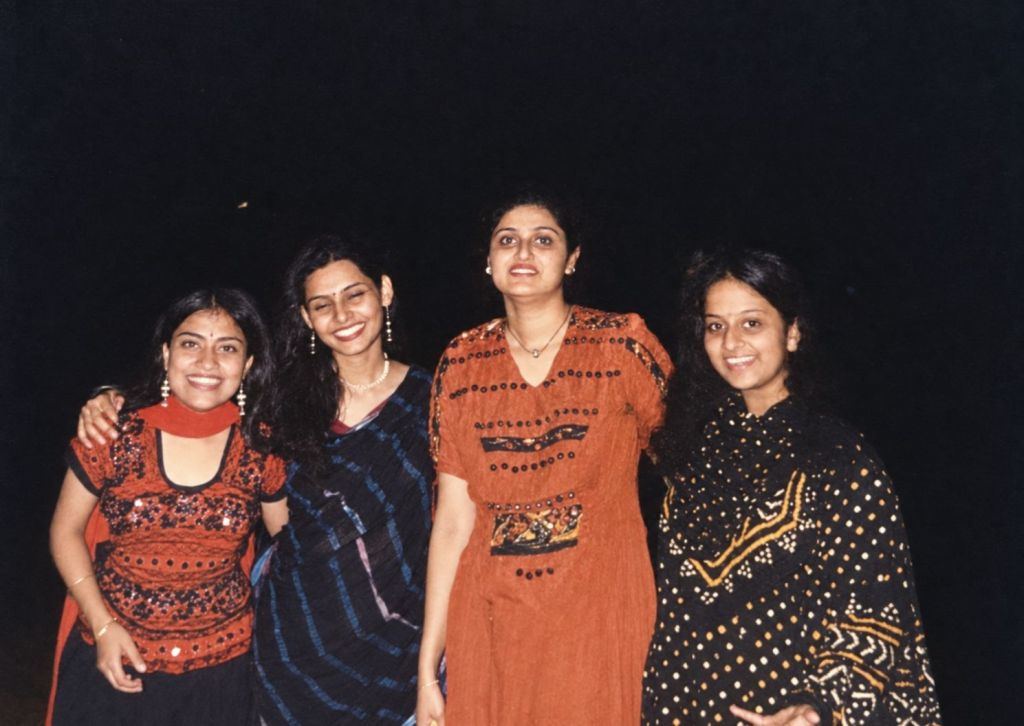
State’s Exhibit D, then. Me at the garba ground, bandhani and jewellery, arms around my friends, at the edge of the floor. The exhibits tell you that the costume was never the difficulty. A costume is easy when you have a certain level of privilege and a Prime subscription; it can arrive in under twenty-four hours, a tad quicker than it took Amma to sew my Bhagyashree outfit. The problem, ultimately, is one of physics: how to get intent and costume to conspire. At the garba ground I had the bandhani and the jewellery, I was culturally fluent and sartorially correct, and yet nobody in that room saw me dance.
I have not danced in over two decades now.
And so I come back to the song, which meant something to me in 2001, as Javed Akhtar had perhaps intended when he wrote it. The real question is what it means twenty-five years on.
Hum hain naye, andaaz kyun ho purana.
I am purana now. Very purana. Somewhere this year there was an induction at some company where a hundred twenty-two-year-olds danced to a song I am pretty sure I have never heard, and forged connections, and felt sufficiently convinced of their own newness.
That is the ordinary and unremarkable thing that happens to everybody, because honestly the biggest hit of 2001 could have been something else entirely and we would have attached some meaning and life lesson to that instead. However, of everyone in that hall in Himachal, and I will not claim to speak for others, I can say this about myself: my andaaz is unchanged.
Everybody else got twenty-five years of sensible adaptation. The anarkali sat down in 2001 and she is still there. Only the heap around her keeps changing.
That song, the one which captured the imagination of a generation of being the new, is no longer the anthem. It hasn’t been in a while. It still has one job, though. Five-odd minutes behind a closed door on a Thursday morning, performed for nobody, badly in places and, just perhaps, not badly in others.
In Allahabad there was no mirror in the house and I assumed I was very good. I have spent the last few decades acquiring the mirror. I should know better now, you know, because I have eyes. But I don’t let that get in the way.
So the next time that song comes up on my playlist, I will make sure the house is empty, shut the door, and force every wisp of hair into a top knot.
I have always known how to enter a room.
I just need everyone else to leave it first. Please and thank you.
Subscribe if you’d like to read more of my attempts to make sense of things through words.

 Primalsoup
Leave a comment