
On Living Forever With Nothing To Do
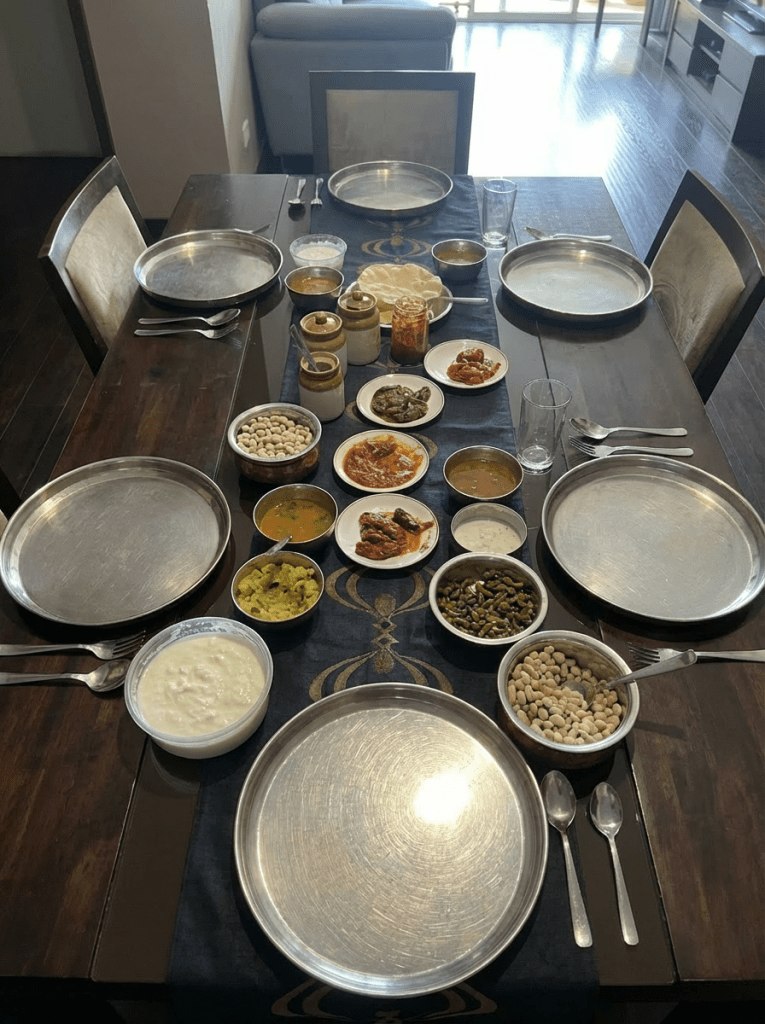
An AI-generated reconstruction of a lunch that had already ended.
At a recent family lunch, three generations agreed on exactly one thing: none of us cared for AI. This consensus lasted approximately fourteen minutes, at which point we realised nobody had photographed the food.
We had committed the cardinal sin of 2025. We had eaten without documenting. The meal, by the laws of modern epistemology, may not have happened at all.
This was no ordinary meal. This was a proper Tamil sapadu: mulangi sambar, rasam, appalam, beans paruppu usili, chow chow kootu, karamani sundal, thayir, lime pickle, and avakkai. The kind of spread that takes a morning to prepare and twenty minutes to demolish. My nieces, who are at the age where gluten is not yet the enemy, ignored most of it and ate pizza. They spent the meal discussing K-pop demon hunters. I did not ask follow-up questions.
So we did what any self-respecting end-times-suspicious family would do. We asked an AI to generate an image of the lunch we had just eaten.
The image it produced was plausible. Stainless steel plates. Small bowls. Appalam stacked in the middle. The grammar of a South Indian meal was intact. If you scrolled past it on WhatsApp, you would nod and move on.
Except there, right in the centre, was a bowl of brinjal curry.
Brinjal. Katrikai. Which no one had made. Which had not been present. Which was, in fact, a lie.
I typed, politely: Please remove the brinjal curry. It was not part of our meal. Stick only to the dishes I mentioned.
The AI responded with a new image. The brinjal was still there. And now there were two bowls of it.
A brief sidenote on brinjal: the world is divided into two kinds of people. Those who love it, and those who find it gooey, slimy, and fundamentally untrustworthy. No prizes for guessing where my family stands. We do not accept brinjal. Not if you call it aubergine. Not if you roast it. Not even if it is phantom AI brinjal that does not technically exist. I personally enjoy a good brinjal curry, but if you asked me to admit this at the table, I would deny it.
And yet here was the AI, insisting. Getting me to accept vegetables my mother never could.
Eventually, we voted to keep the image. The lunch had happened. We had evidence now. Brinjal and all.
For the record, I had not even given the AI a picture of the lunch. I had given it the aftermath. A wiped table. Empty plates. Chairs slightly out of alignment. One aunt lingering because she had not yet found a reason to leave.
Any human would recognise this image instantly. Lunch is over. People have moved on. The important part has already happened.
The AI looked at this and thought: no. This will not do.
It took the end of the meal and politely reversed time. Restored symmetry. Re-created abundance. Inserted brinjal. Because an empty table, apparently, is not a complete story.
The other thing we discussed at lunch, between rasam and pizza negotiations, was longevity. On the surface, it had nothing to do with AI. In practice, it had everything to do with it.
My uncle, who has recently discovered the biohacking discourse, explained that death is an engineering problem. My aunt, accurately, pointed out that he gave up sugar in 1990 and is now prime for starting his own podcast. The nieces remained focused on demon hunters, which felt appropriate.
And I sat there thinking: we are planning to live to 150. Doing what, exactly?
We are extending life at the same moment we are quietly eroding usefulness. Work is changing. Skills expire faster than bodies do. Children leave, systems automate, relevance thins out. You don’t need a dystopia for this to feel unsettling. You just need time.
I grew up with a very particular idea of how a life is supposed to work. Not in a productivity sense, but in stages. You begin by learning. You move on to doing and building. Eventually, if things go well, you step back. You loosen your grip. You prepare to exit the stage without needing an encore.
Lately, it feels like we have decided to skip that last part
Here is what I know about my age.
According to my Spotify Wrapped, I am 102. My most-played genre is something called Vintage Schlager, which I do not remember choosing and do not wish to investigate. The algorithm has concluded I predate electricity.
According to my DEXA scan, my metabolic age is 79. My metabolism has retired. It has moved somewhere warm, taken up bridge, and refuses to process carbohydrates after 4 p.m. I had entered the clinic feeling vaguely tired. I exited wondering if stairlifts were covered by insurance.
According to my Friday nights, I am either four or ninety. My ideal evening involves being horizontal by eight. Invitations that begin after nine feel aggressive.
According to my workplace vocabulary, I am Medieval. I recently used the thumbs-up emoji in a chat and was informed it was “passive-aggressive” and “old.” I replied “noted,” which apparently escalated the situation.
If you average these numbers, 102, 79, four, and Medieval: I am statistically deceased. And yet here I am, eating sambar, being gaslit by image generators, unsure which stage of life I am meant to be in.
Growing up Hindu and middle-class, I was taught that life has stages, brahmacharya, grihastha, gradual withdrawal, sanyasa.
You begin by learning. You move on to earning, building, and sustaining. And if you are lucky, you spend your later decades letting go, not because you have failed, but because you are finished. Death, when it comes, is not theft. It is release.
The system assumed you would live to seventy, maybe eighty. It assumed the arc would bend somewhere. It assumed you would eventually have something to renounce.
Now the billionaires want to live to 150. They are on metformin and rapamycin, tracking biological age the way traders track markets. Death is a bug. Longevity is the fix.
But nobody seems to be asking the obvious question: 150 years of what?
I suspect the billionaire answer is grihastha forever. The householder stage stretched into infinity. Eighty years of earning and wanting and accumulating, followed by another eighty of the same. No withdrawal, because withdrawal is failure. No renunciation, because what kind of loser renounces?
Meanwhile, we are outsourcing everything that once filled a life.
At that same lunch, my cousin mentioned that a teenage boy in her walking group had told her he has an AI girlfriend. She has since changed her walking route. The nieces were untroubled. Demon hunters remain the priority.
This is the convergence of our time: longer lives, fewer reasons to live them. We are biohacking our way to 120 while machines take over the thinking, the making, the doing. We will have all this time, and nothing obvious to fill it with.
What do you do in the forest when there is no forest and nothing left to retreat from? What do you renounce when you spent your life optimising, documenting, and arguing with a machine about whether brinjal was present?
Forbes publishes a list every year: 30 Under 30. Young achievers. Precocious success. The message is clear: if you did not do it young, you missed your chance.
But if we are all going to live to 120, the metrics need updating. I propose a new list.
120 Under 120.
Criteria: you are alive. You have not yet died. Congratulations. You have achieved the baseline goal of the longevity movement.
Categories include:
Most Years Spent Unsure What To Do With Them. A competitive field.
Longest Gap Between “Potential” and “Achievement.” I am a strong contender.
Best Use of Extra Decades to Finally Get Around To It. Winner to be announced in 2075.
Most Convincing Impression of Someone Who Has It Together. Lifetime achievement award. Presented at 119, or posthumously.
Here is my confession: I am a late bloomer.
By which I mean I have not yet bloomed. By the traditional calendar, I should be settled, productive, handing things down. Instead, my life stage is best described as pending.
And yet, if we are all going to live to 120, maybe “late” stops meaning anything. Maybe I am not behind. Maybe I am simply on the new timeline. The one where blooming at fifty is not failure, just a different season.
The billionaires want longevity so they can accumulate forever. More years, more empire, more.
But maybe longevity is actually a gift to the slow ones. The late ones. The ones who were starting to panic about the frost.
Maybe 120 years is not about doing more. Maybe it is about finally arriving at something worth withdrawing from.
To have, at last, something to renounce.
I’ll let you know how it goes.
Subscribe if you’d like to read more of my attempts to make sense of things through words.


Leave a Reply