
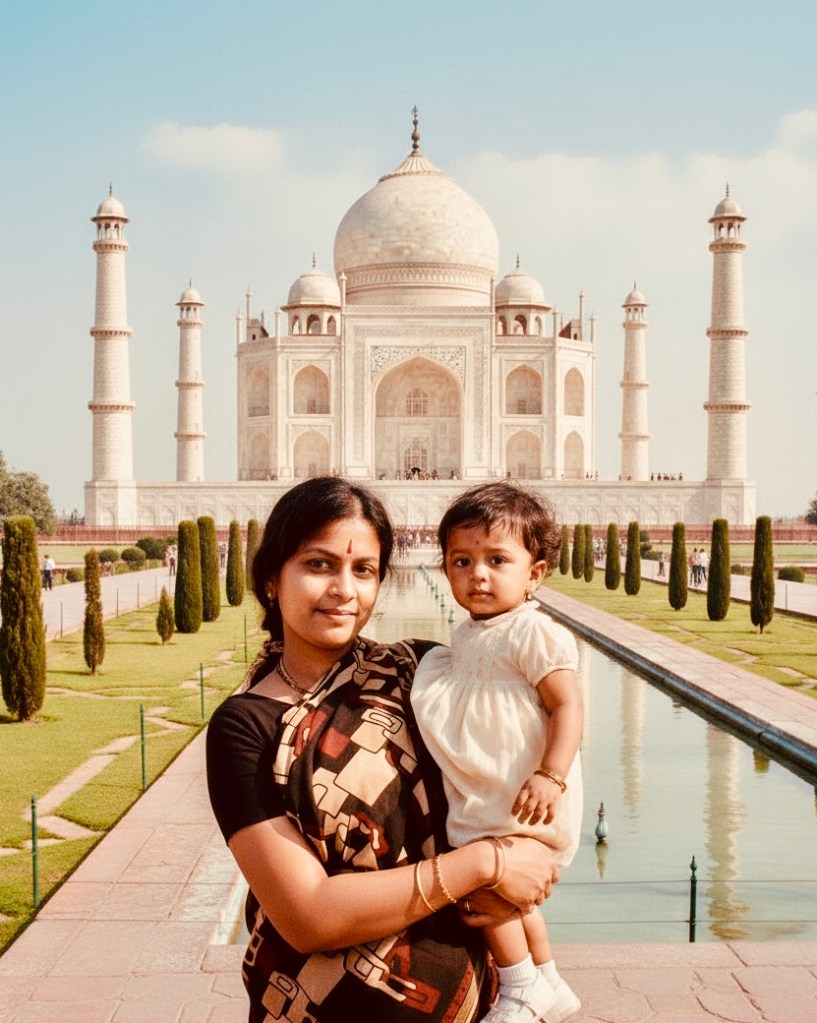
AI-generated image: my mother and me at the Taj Mahal, a trip we never took.
Forgive me, for I have mid-journeyed.
I asked the machine to bring my grandmother back, not as she was when she died.. frail, sharp, and opinionated, but as a young woman standing in front of the Eiffel Tower, a place she never went. She looked good in a beret. I saved the picture.
Forgive me, but I also asked it to show me what my childhood home would look like if it hadn’t been torn down, if it had been painted teal with bougainvillea spilling over the gate. Forgive me, I saved that picture too.
Then I went further. I asked for the lives I never had: me as a Kathak dancer, me as a Harvard professor with too many scarves, me on a sailboat with someone who might have been my husband in another draft of existence. The machine obliged, spitting out a series of images that felt like the photo album of a ghost, familiar, possible, and completely fake.
And yet, scrolling through them, I felt the peculiar ache of nostalgia for things that never happened. Nostalgia without a past. Memory without an event.
Lately, I’ve even begun inserting myself into these ghost timelines.
There’s a real photograph of my mother holding me as a baby in our small Pune home. Same sari, same baby, same pose. The AI version moves us in front of the Taj Mahal. A place we never went when I was small. We lived in Delhi for years, but there was never enough time, enough money, enough something to make those little weekend pilgrimages to monuments.
I did go to the Taj later, with my mother. By then I was taller, heavier, bolder. She couldn’t lift me into that perfect pose anymore.
Looking at the AI image, I don’t see a fake. I see a parallel life: the trip we didn’t take, the photograph we didn’t pose for, the version of us that existed only as a possibility. It fills me with a strange, double feeling: joy at seeing us there, sadness at knowing we weren’t.
Maybe in another version of my life, we went to the Taj when I was small, and my mother held me against her hip while the domes gleamed behind us.
Maybe in another one, my grandmother really did wear a beret in Paris, and I inherited her cheekbones along with her stubbornness.
Maybe in another one, we had the money, the time, the tickets, the lives we didn’t get.
The machine can’t tell me which version is true, only which one I wish had been.
But it isn’t only my past I’ve been reimagining. Ten, maybe fifteen years ago, I started writing my first novel. I am still writing. In that time, I’ve also been quietly curating my future author photos. Because let’s face it: every female writer from the subcontinent whose prose has dazzled me in the last few years has also dazzled me with her cheekbones.
Cheekbones and jawlines have never been my strong suit. But with AI, there I was: hand-woven thrifted sari, writerly smirk, cheekbones et al. Magic. A version of me that looks like she has a book deal, a residency in Tuscany, and a publicist who knows how to pronounce her name at prize ceremonies.
Scrolling through that image is like glimpsing a parallel career: the covers I haven’t published, the panels I haven’t sat on, the Instagram accounts I haven’t curated. It’s ridiculous, but it’s also irresistible.
We used to think of photographs as evidence. Proof that something occurred. That you were once that child in braids. That your parents once smiled at each other on a beach. That a certain cake was indeed baked and eaten at your seventh birthday. Proof was grainy, occasionally overexposed, but irrefutable.
AI images undo that bargain. They don’t prove anything. They suggest, they invent, they flirt. They’re the friend who makes up a story so well that you remember being there.
Do I believe these pictures? No.
Do I feel them? Absolutely.
And maybe that’s the point. AI doesn’t just conjure images of the future… it manufactures the ache of alternate pasts. It hands you an entire box of counterfeit nostalgia, knowing full well you’ll open it anyway.
So forgive me. Forgive me for asking the machine to show me who I was not, where I did not go, and who I did not become. Forgive me, but I saved those pictures. And every now and then, late at night, I look at them again, like a woman sneaking glances at a stranger’s photo album, realizing with a jolt that the stranger might have been her.


 Primalsoup
Leave a reply to Anna Cancel reply