
The one who writes love stories to children who will never exist
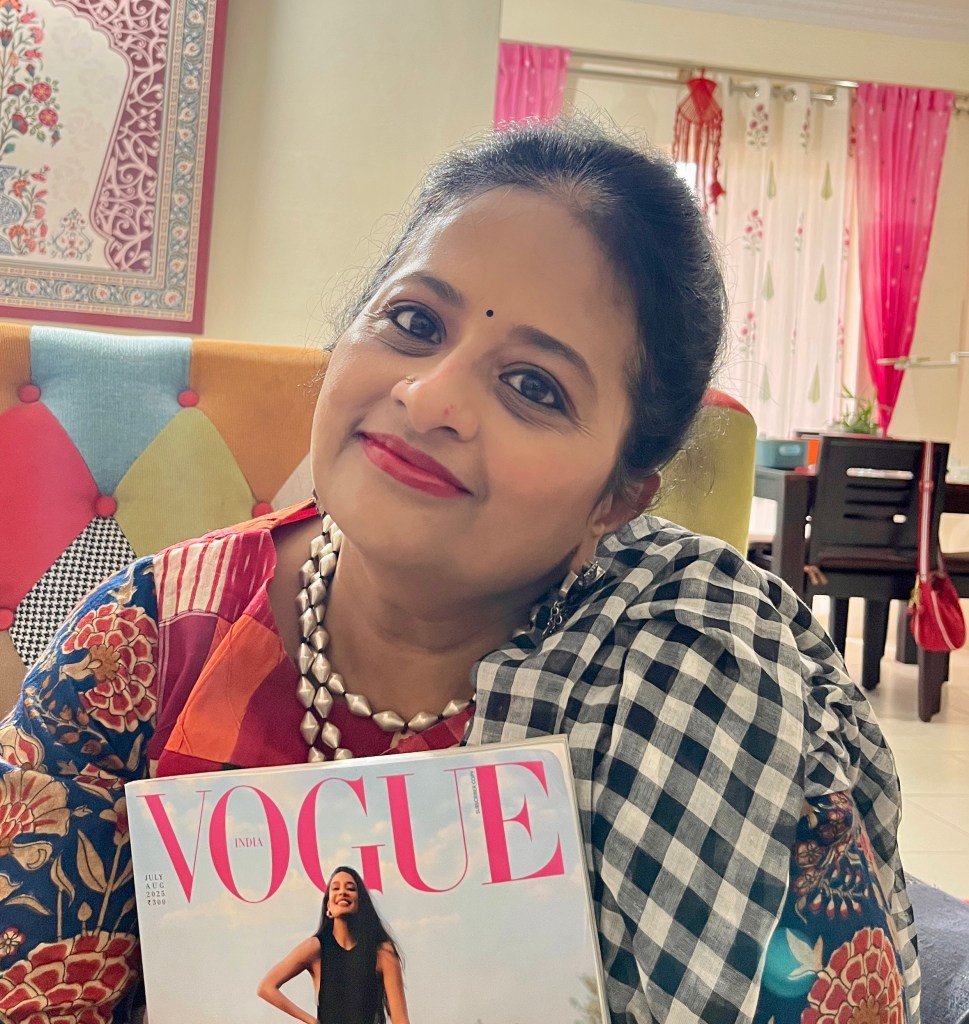
The girl I brought home, with her collection of becoming.
I don’t have a lot of wealth, but I have a lot of crap.
Earrings that I bought during various phases of optimism. Books that I’ve accumulated like some people collect frequent flyer miles. Lego sets that I tell myself are “investments” but really just make me happy on Sunday afternoons. Every issue of Vogue India since it launched in 2007, because I thought that’s what sophisticated women did – save magazines like they were documenting their own evolution.
And in a way, they were. Flipping through them now, I can see not just changing fashion but changing dreams. The relationship advice I highlighted shifts from “how to keep him interested” to “how to know what you want.” The career features evolve from women “having it all” to women “defining it all for themselves.” Seventeen years of my own evolution, archived in glossy pages.
I tell my nieces they’ll inherit all this crap someday. They shrug the way Gen Z does at the prospect of all the paper and plastic that will eventually come their way. To them, it’s just stuff their weird Athai collected. They can’t see the stories each piece holds, the version of myself I was trying to become when I bought it.
The earrings alone could tell you the entire history of my romantic disappointments. The bold silver hoops I bought before meeting the Singer, thinking I needed to look more “artistic.” The delicate pearl studs I wore to coffee with the Boy Who Objected to My Nose Pin, trying to appear traditional enough to compensate for the piercing. The statement gold chandbali I splurged on for the family function where I met the Boy from Osaka, convinced that looking expensive might make me seem like better daughter-in-law material.
Each purchase was a small act of hope. A costume for my unlived lives..
And yes, at times I wonder about the children I never had. Not in a wistful, biological-clock way, but in a purely speculative sense. Like alternate timelines branching off from each of those almosts.
The Singer’s child would have inherited his musical ear and my tendency to overthink lyrics. They’d probably be the kid who corrected their music teacher about rhythm patterns and wrote unnecessarily complex song analyses for school projects.
The World-Saver’s offspring would have grown up believing they could fix everything – climate change, inequality, their parents’ relationship. They’d be the teenagers organizing school protests and writing earnest essays about social justice, probably driving me crazy with their idealism while making me secretly proud.
The Regular’s children would have been the most interesting ones. Born into that particular brand of shared humor, raised on inside jokes and cultural commentary. They’d be the kids who understood references no one else got, who found the absurd in everything, who’d probably become critics or comedians or both.
The Boy Who Ticked All the Boxes would have produced practical children. They would be well-adjusted kids who had earnest faces, did their homework on time, would always finish their school tiffin boxes, and grew up to have sensible careers and stable relationships. The kind of children who’d visit regularly and never give their parents cause for worry.
Each imaginary child is a small tragedy of specificity. These phantom children would be teenagers now, some of them in their twenties. They’d have their own Instagram accounts, their own relationship disasters, their own career anxieties. They’d probably find my Vogue collection as ridiculous as my actual nieces do.
But they’d understand why I kept them. They’d know that each issue was purchased during a different phase of trying to become someone worthy of their eventual existence.
Friends and family often describe me as… somewhat maternal. Nurturing. The one who will send you handmade gifts, who checks in during difficult times, and someone who would dole out advice, both asked and unasked with equal vigour. A few years ago, at work, during a performance review, one of my key areas of improvement listed was, ‘don’t be such a protective mother bear to your team’.
I am good at taking care of people. Apparently, I was built for it.
So what does it mean to be childless when everyone around you sees you as naturally maternal?
It means mothering everyone else’s stories while your own potential children remain locked in imagination. It means being the person who everyone comes to for parenting advice despite never having been a parent. It means watching other people’s children grow up and feeling both invested in their futures and utterly peripheral to them.
It means accumulating crap instead of creating people.
But what have I gained by not having what I’m supposedly meant to want? Original joys that no one else’s schedule dictates. Solitudes that belong entirely to me. The luxury of changing my mind about who I am without consulting a partner or considering a child’s stability. The freedom to mother ideas instead of people, to nurture stories instead of futures.
The last time I came home from a bad meet-cute, I didn’t call anyone. No emergency debrief with friends. No Notes app poetry about storms and silence. I didn’t even check if he’d messaged. I just got rid of my too-wired bra, made filter coffee at 11 PM (scandalous), and sat on my kitchen floor in my overpriced mul cotton saree, doomscrolling to not have to be alone with my thoughts.
The coffee was too strong, the way I’d learned to like it during late nights of overthinking text messages. The cotton felt cool against the tiles, expensive and slightly ridiculous – like wearing evening wear to the grocery shop. But I wasn’t performing anymore, I wasn’t calculating how the scene might look to an audience.
That’s when I saw her clearly. The girl who’d been there all along.
I wasn’t particularly graceful. I’d eaten French fries in an auto after Nose Pin Boy’s judgment. I’d screenshot Digital Boy’s poems and reread them like sacred texts. I’d invented seventeen different personalities for seventeen different boys, trying to find which version of myself was loveable.
But I was still here. Sitting on the kitchen floor. Drinking coffee that would keep me up all night. Laughing, actually laughing, at the absurdity of wearing a handwoven sari to meet someone who turned out to collect cryptocurrency.
I met myself again and again after that. In the mirror at Fabindia, buying another overpriced kurta with money I could have spent more responsibly. At my neighbourhood darshini, eating benne dosa quickly and efficiently in a shared table with strangers and not pretending to wait for anyone. And some years ago, in my mother’s eyes when I finally said, “Stop sending profiles. I’m okay.”
I wasn’t always easy company. I overthought text messages. I gave men, whom I didn’t even like, the power to ruin my Tuesday.
I performed confidence while holding coffee cups like shields. But slowly, I stopped auditioning.
Each almost-relationship taught me something elemental about the self I was becoming. The Singer showed me I could survive being found wanting. The World-Saver revealed the relief of admitting our paths didn’t align. The Regular proved that some people are meant to be witnesses to your story, not co-authors.
My Lego sets sit on shelves like very expensive, very colorful monuments to a life lived for one. My nieces humor me when I show them my latest creation, but I can see them wondering why a grown woman spends her disposable income on toys.
Because I can, I want to tell them. Because no one is depending on me to save for their college education or music lessons or summer camps. Because my money goes toward things that make me happy instead of things that make other people functional adults.
Because this is what freedom looks like when you didn’t choose it.
The phantom children of my almost-relationships will never inherit my Vogue collection or roll their eyes at my Lego obsession. They’ll never exist to give meaning to my maternal instincts or purpose to my accumulated crap.
But the girl I brought home? She orders dessert at the end of a bad day. She knows her nose looks fantastic with a diamond pin. She can say “investment banker turned savior” without rolling her eyes, but also without bitterness.
I didn’t meet your father. But I met myself. Every time I came home.
And honestly? I’m terrific company. Even on Wednesdays.
This is the end of How I Did Not Meet Your Father, a series in which I mined my non-existent love life for content, and accidentally found something else entirely.
Read the entire series
Preface, Episode 1, Epsiode 2, Episode 3, Episode 4, Episode 5, Episode 6, Episode 7, Episode 8, Episode 9, Episode 10
Subscribe if you’d like to read more of my attempts to make sense of things through words.


 Primalsoup
Leave a comment