
It is March again, and this year will be different.
I know this because the spring-summer collections have begun dropping in my inbox, because a linen shirt has been sitting in my saved-for-later cart for eight months now, and because I am standing in front of my wardrobe having decided, once again, that I will actually purge. I will become a minimalist. I will achieve the clean, airy wardrobe of someone who owns fourteen considered pieces and wears each one with quiet confidence.
I have three motivations, which I will be honest about. One: I cannot bear to open this wardrobe every morning and be confronted by the sheer volume of decisions I have accumulated. Two: I need to make room for the linen shirt, physically and morally. Three: something needs to change, and a wardrobe purge is cheaper than therapy and more socially acceptable than a dramatic haircut.
I open the doors.
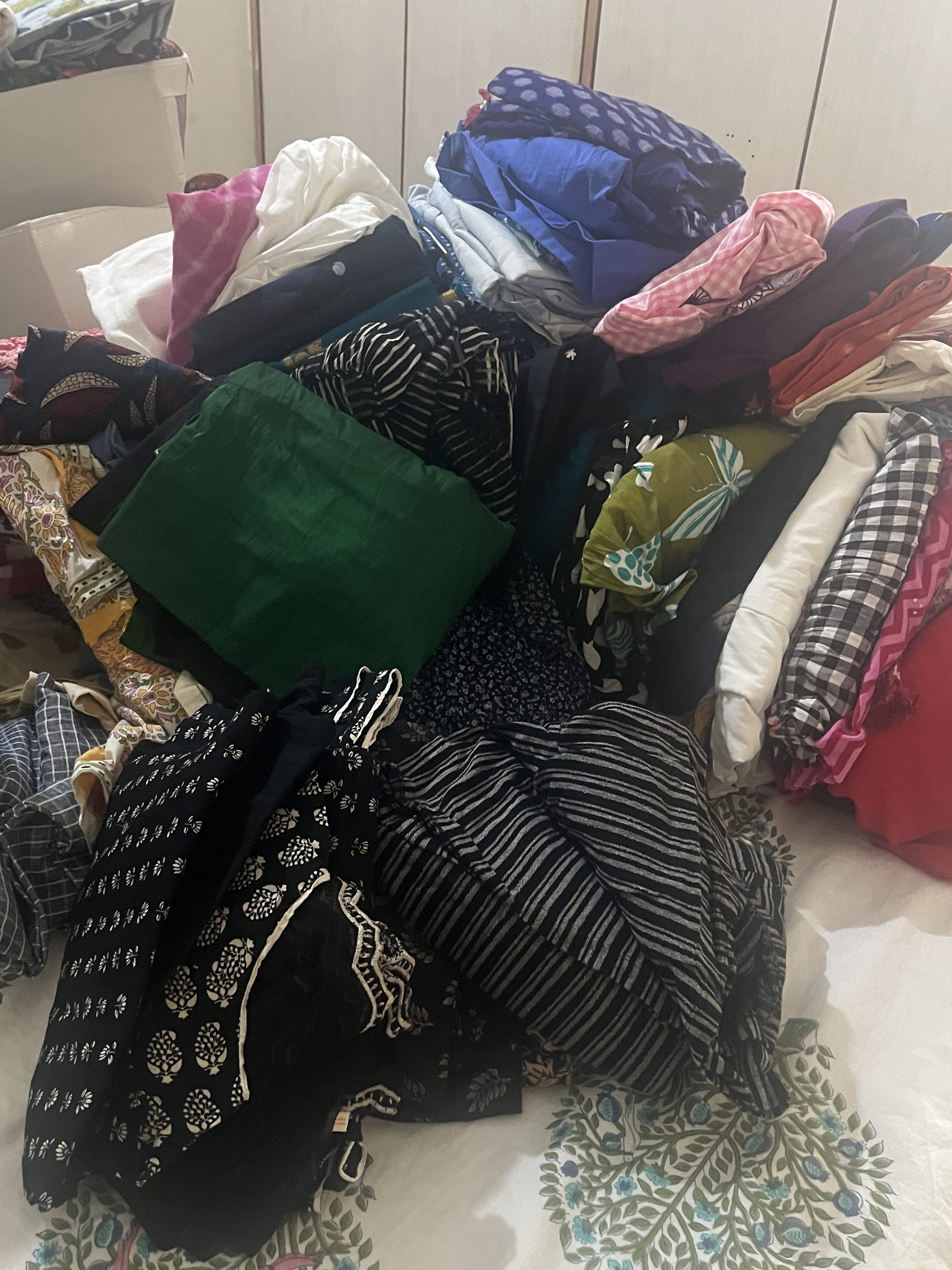
Inside: approximately two hundred garments. A blue silk dress that has never been worn. Three pairs of jeans in ascending order of optimism. A kurta I cannot wear because it pokes me in the armpit, but which is, objectively, art. A dupatta that belonged to a version of me I have not seen since 2006. The wardrobe looks back at me without expression. It has seen me before.
To understand how two hundred garments happened, you need to understand that this wardrobe is not a collection. It is a stratigraphic record. Archaeologists could date each layer.
At the bottom: my mother’s era. Before Pinterest, before the internet, she would study women’s magazines and sew me clothes from fabric bought at Lajpat Nagar market, dyed to match the colours that Ritu Beri and Tarun Tahiliani models wore on the page. Lace from Kinari Bazaar. Embroidery she added herself. She had an eye and she gave it to me, which is the most useful thing anyone has ever given me and also, in retrospect, the source of all my problems.
Then college, and my first experience of fashion as a personal decision rather than a maternal one. M Block Market was the aspiration. Sarojini Nagar was the reality. My mother was not happy. This is the fast fashion layer, thin and slightly embarrassing, like a geological era that lasted too long.
Then Fab India, which was my entire twenties. Khadi, block prints, vegetable dyes, one tiny flower embroidered at the back. I was also, in this period, the most creative I have ever been with clothes, mixing and matching without knowing what colour theory was, trusting the eye my mother gave me. This is the richest layer. This is where the dupattas are.
The dupattas deserve a separate mention. I accumulated, in my Fab India era, a collection of dupattas that is genuinely stunning and which I still own fifteen years later because unlike the kurtas and salwars, they were not subjected to the washing machine. I washed them by hand. With L’Oreal shampoo. Because they were worth it.
Then Bombay, and the Westside era. Clothes that could withstand the city’s infrastructure: harder, mass-produced, reliable. The thing about Westside is that most women had the same idea, which meant that on any given Monday, you would board the local train and find your colleagues, your clients, and three strangers all wearing the identical kurta. There was a nod. A moment of silent acknowledgment. A private question of who wore it better. And then you let it go, because it had pockets, and once you have pockets you cannot go back. I have given away dresses I loved because they had no pockets. I have kept dresses I liked less because they did. This is not irrational. This is values clarity.
Then my forties, which is when I finally stopped dressing for anyone else. Not for the male gaze. Not for the job I wanted. Not for the body I was supposed to have or the occasion I was supposed to be attending. Just: liked it, so wore it. This turned out to be the most radical fashion philosophy I have ever encountered and it took me four decades to arrive at it.
I discovered I like dresses. Big ones, small ones, anti-fit ones that swallow me whole. I discovered colour blocking, not as a trend but as a joy. I discovered that bohemian was not an aesthetic I had missed but a permission I had not given myself. I started buying things because they made me happy in the shop, not because they made me look a particular way or signal a particular kind of person. The gingham dress. The silk coord set. The kurta with the ridiculous embroidery that pokes but is undeniably beautiful. All of it: liked it, so wore it.
The one remaining negotiation: a polka dot sleeveless dress, never worn, waiting for a body or the ability to accept the one I have, whichever comes first.
I am a responsible consumer. I do not panic-buy. I do not succumb to flash sales. I have, on more than one occasion, put something back on the shelf after calculating its cost per wear. I have a system. I have, in fact, a spreadsheet. The spreadsheet has eleven tabs. The tabs are: Summary, Kurtas, Ethnic Bottoms, Dresses, W Bottoms, W Tops, Nightwear, Coord Sets, Winter, Lingerie, and a final tab whose name I will not reveal because it contains evidence I am not prepared to submit at this time.
I pull the first thing out.
* * *
It is the company t-shirt.
It was white once. It is now the colour of everything that has happened to it: turmeric from the dal, blue ink from a data session involving post-it notes and a marker that had opinions, and a greenish tinge along the left shoulder from a green kurta I own and love and forget to separate during every single wash cycle without exception. It is the most honest thing I own.
I put it in the keep pile.
The green kurta that committed the laundry crime is also staying, obviously. I have had it for years. It is magnificently, unapologetically boxy. Fashion influencers and Vogue magazine will tell you that certain outfits transition seamlessly from day to night. The green kurta is that outfit for me. Respectable enough for the day, comfortable enough to sleep in at night. A nightie that has not yet admitted what it is.
It has bled since the first wash. Will bleed, I now understand, forever. After approximately a hundred washes, it is still releasing colour into the world, into my whites, into my company t-shirt, into every light-coloured garment that has the misfortune of sharing a drum with it. I have my sincere apologies to offer to every light-coloured cloth, past, present, and future. You deserved better. I cannot promise it will not happen again.
My actual daily wardrobe is four t-shirts. The company one, now a chronicle. A t-shirt from grad school, for nostalgic days. A t-shirt that says Alexa, overthrow the government, for days when I need the world to know exactly where I stand. And a t-shirt with Shah Rukh Khan on it, arms stretched wide, and the words bade bade deshon mein across the chest, for days when I require the specific comfort of a man who has never met me but would, I feel certain, understand.
That is my capsule wardrobe. Four t-shirts. Two moods. One parasocial relationship. One ongoing laundry crime.
Behind me, as I wear these four t-shirts in rotation: two hundred garments, waiting.
* * *
I reach into the wardrobe and my hand finds the jeans.
Of course it does.
Growing up, I did not wear jeans. My mother made our clothes: frocks and skirts, practical and pretty, stitched on a Singer that had opinions about certain fabrics. Jeans were a foreign country. They were also, it turned out, a country with border control issues when it came to my specific geography.
So when jeans became socially non-negotiable, my mother took me to Delhi’s famous Mohan Singh Market. The masterji there operated with the confidence of a man who had seen everything and judged nothing. You told him what you wanted. He produced it. The label said Pepe or Levi’s or Gap, depending on what your poison was that season, and the fit was, miraculously, correct, because the masterji did not care about your size. He cared about your actual body. These were not jeans you had to persuade yourself into. These were jeans that were, simply, yours.
I still did not like jeans. I wore them when my mother made the economics argument. Cost per wear, she said, years before I had a spreadsheet. I wore them with Fab India kurtas and silver jewelry from Janpath and I was, I am willing to admit, extremely that girl. You know the one. The one who was very pleased with herself. And who had opinions about handloom.

Fab India deserves its own essay. Its own discipline. Possibly its own wing at the National Museum.
There was, at the time, one Fab India store in all of Delhi. It was in Vasant Kunj, next door to where I lived, which I chose to interpret as fate rather than real estate. My aunt took me. I walked in and did not walk out the same person. Here was cotton that breathed. Here were block prints that asked nothing of you. Here were silhouettes that said: we know you. The clothes were expensive, which my mother pointed out. They were also, I discovered, structurally allergic to washing machines. One cycle and they became a different, sadder garment, a ghost of themselves. They were boxy. They were aggressively unfeminine by conventional standards. I did not care. For fifteen years, my personality was Fab India. The brand has since spread across the country like expensive fungi, but I knew them when there was only one.
At peak Fab India, I was also, and I say this with no pride and no regret, twinning with my home upholstery. We wore the same prints. The curtains and I had an understanding. This is the kind of thing that happens when you commit fully to a brand.
Fab India and I no longer have that relationship. I have not bought anything from them in years, not for any dramatic reason, not a falling out, just the slow drift of abundance. Now there are options everywhere, and somehow that means I buy less, which is its own kind of irony. But sometimes, at an airport, I will spot a Fab India and I will go in. I will look around. I will touch a few things. I will leave without buying anything. It is like running into someone you used to be inseparable from. You are still fond of them. You just do not need them the way you once did. You are glad they exist in the world.
The silver jewelry from Janpath, for what it is worth, is still in the wardrobe. It is not going anywhere.
Now. The jeans.
In my thirties, before I went back to writing school, I decided it was time. Real jeans. My jeans. Not the masterji’s jeans, excellent as they were. I walked into a mall. I had spent a lifetime not fitting into standardised sizes and had developed elaborate coping mechanisms as a result.
The salesperson looked at me. Just looked at me. No tape measure. No consultation. He disappeared and came back with a pair of Levi’s skinny jeans and said, try these.
I took them into the fitting room. I held my breath. I pulled them up. And they fit. They actually fit. Not in the way that things fit when you are willing to accept some degree of suffering. They fit the way things fit when someone has correctly understood the shape of you.
I stood in that fitting room for a moment longer than necessary. I was having a feeling. The feeling was: oh. So this is what it is like.
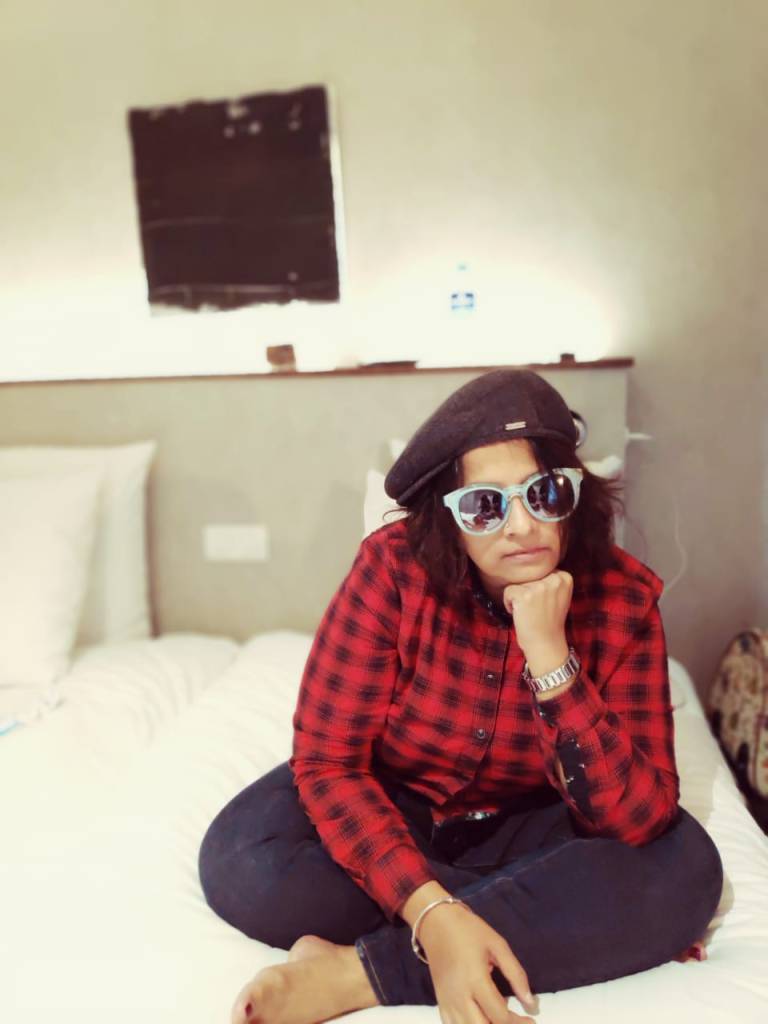
I bought the jeans. I wore them for years. They held my shape and I held theirs, which is the correct relationship between a person and a pair of trousers.
And then Gen Z happened.
Skinny jeans, apparently, are over. Have been over. Were over before I learned they were over. My nieces look at my jeans the way archaeologists look at artifacts: with interest, with distance, with the careful neutrality of people who do not want to cause pain but cannot pretend the artifact is contemporary. The side eye is quick. It is devastating. It contains multitudes.
I put the jeans in the keep pile.
The jeans are never leaving the wardrobe. Though I will say this: if they ever do leave, they will go to the nieces. Not as a hand-me-down. As an heirloom. There is a difference, and I trust them to figure it out eventually.
* * *
I pull out a kurta. A slightly mangled, barely-there bandhani kurta in what was once a deep blue, now faded to something softer and less certain of itself.
This is where I need to explain something about how attachment actually works, because it is not what you would think.
You would think I am attached to the expensive things, the branded things, the things in the best condition. You would be wrong. I am attached to the irreproducible things. There is a kurta from a lane in Jaipur that I paid three hundred rupees for that I would sooner part with a kidney than give away, because that lane, that vendor, that particular bolt of fabric in that particular colour no longer exist in the same combination. I was there on one specific afternoon and I bought it and now it is the only evidence that afternoon happened. Newer is not better. Newer is, if anything, more expendable. The older something is, the more it has survived, and the harder it is to justify releasing it.
This is also why I am more attached to my first clothes than my recent ones, in the same way I am more attached to my first jobs, my first friendships, my first city. They are constitutive. They are part of how I became who I am. The kurta from the Jaipur lane is in average condition and I do not care. A brand I can find again. That afternoon I cannot.
It goes back in the wardrobe.
* * *
I pull out the blue silk dress.
It is electric blue with an olive green hem that rises in points like a wave coming in, and flutter sleeves, and the kind of silhouette that requires a life to match it. It has never been worn. The tags are still on it.
I bought it in 2025, five years into remission from cancer, for a gathering of fellow survivors. Five years is a milestone. It felt like the kind of occasion that deserved a dress that knew it was a dress.
The event was cancelled.
Since then, I have held the dress up on several occasions and looked at it and thought: not yet. A dinner? No. A friend’s birthday? No. A work thing? Absolutely not. The dress was bought for a specific quality of joy, the joy of still being here when the odds suggested otherwise, and I cannot seem to reassign it to a Saturday that happens to be nice.
So it waits. Electric blue and perfectly pressed and entirely ready for a day I keep not being able to find.
I understand, intellectually, that the day will not arrive in the form I am imagining. That joy does not announce itself in advance and hold still while you find the right outfit. That if I wait for a moment worthy of this dress I will die owning it unworn, which would be its own kind of tragedy.
I put it back anyway.
Not everything in a wardrobe is about clothes.
* * *
I pull out something heavily embroidered, with small mirrors sewn into the fabric that catch the light and throw it back at you, which in a shop feels like magic and in real life feels like a dare.
At this point in my life, I am a cotton-linen person. Full stop. If a garment contains sequins, lace, anything that catches, pokes, digs, or makes a sound when you move, I want no part of it. I have worn enough structured things to know that fashion and comfort are, at best, on speaking terms.
And yet. I bought this because leaving it in the shop felt like a moral failure. It was too beautiful to abandon to someone who would not appreciate it properly. It belongs in a museum. It belongs on a wall. It does not belong against actual human skin for more than eleven minutes, which is roughly how long it takes for the embroidery to begin its conversation with your ribcage.
It stays. It is art. Art does not have a cost per wear.
* * *
I pull out a dress I barely recognise.
I bought it in a moment of grief-adjacent shopping, looking for the closest approximation of something I had given away years earlier and subsequently seen in a photograph and spent months trying to replace. This dress is that approximation. It is almost right. It is almost the thing I lost. It is not the thing I lost.
Here is what happened to the original.
There was a practical move, the kind where something has to give, and I was being sensible, I was not going to be a person who kept a kurta for sentimental reasons when someone else could actually wear it.
The woman who did my nails was, as it happened, my body twin. Fat but petite, the same distribution of self in roughly the same amount of space. Finding a body twin is rare and you recognise it immediately. I knew my clothes would fit her. I also knew she would appreciate them, because she had told me so. We were mid-conversation, the kind you only have with people doing your hair or nails, when she looked at what I was wearing, one of my Fab India era combinations, my mother’s colour theory applied without thinking, and said something generous about it. There is nothing that makes you more giving than being seen. I went home and gathered things for her. She was delighted. I was, briefly, a good person.
And then one day a photograph surfaced, and there I was: younger, clearer-skinned, wearing that kurta, and I went straight to the wardrobe knowing it was in there and it was not in there, and the nail lady was out there somewhere wearing my happiness and I could not get it back.
Half these clothes cannot be replaced because they were made: some masterji cut them from fabric I picked up at a khadi somewhere, and that bolt of cloth no longer exists, that masterji may no longer exist, I was a different body on a different day and the combination is gone. The nail lady did not take a kurta. She took the only existing record of a specific afternoon that no longer exists in any other form.
The replacement dress is fine. It is close. It is not the thing.
The kurta itself was nothing remarkable. A decent white cotton with a pink dupatta, the kind of thing I wore on unremarkable Tuesdays. But the photograph had done something photographs do when they arrive without warning: it had scrubbed off everything else and left only this: a version of me that looked like she knew something, or believed something, or had not yet stopped believing it. I was not trying to recover the kurta. I was trying to recover her. The kurta was just what she happened to be wearing.
I know this. The replacement dress stays anyway.
* * *
I find a dress at the back and put it straight in the bin without looking at it properly.
I am not a superstitious person. I want to be clear about this. I believe in evidence. I believe in rational analysis. I have read Kahneman. I understand that the human brain is a pattern-seeking machine that finds causation where there is only coincidence, and I find this intellectually interesting rather than personally applicable.
And yet.
There are clothes I cannot keep because something happened while I was wearing them. My mother died. I fell. Something broke, in the larger sense of broke. I cannot donate these clothes. I cannot, in good conscience, pass that on. It seems like something you do not do to a stranger.
So they go straight in the bin. No ceremony. The dress did nothing wrong. The dress was an innocent bystander. But the dress knows what it witnessed and I will not subject someone else to its knowledge.
The inverse, I should note, does not apply. When something wonderful happens while I am wearing something, I do not conclude that the garment is lucky. I am a rational person. The law of averages is not in the business of endorsing specific garments. Correlation is not causation.
The good-event dress goes back in the wardrobe.
The bad-event dress goes in the bin.
I see no inconsistency here.
* * *
I sit down on the bed, on the one small corner not covered in clothes, and I think about my mother.
She had a system. I have always had a system too, but hers worked.
In the small towns where I grew up, there were vessel sellers who came through with a specific proposition: your old clothes for new stainless steel. The exchange rate was understood, more or less. My brother’s and my clothes, small, numerous, worn to near-retirement, might yield a steel tiffin box. My father’s trousers and shirts moved the needle further. His baniyan vests had no value in this economy and were repurposed as dusters without ceremony or sentiment. His dhotis, also ineligible for barter, were cut into wide flat sheets and used to sun-dry papads and vadams and the assorted ambitious preserves my mother produced every summer.
Everything had a destination. Everything had a next life.
But the saris. The saris were different.
My mother was the only one in the household who wore saris, which made her the only one with real leverage. She had four or five she was prepared to part with on any given occasion. She never led with them. The vessel seller would arrive, and she would begin with the children’s clothes: small, plentiful, easy to dismiss. Then my father’s shirts. Then a pause. A considered pause. She would let the exchange reach its natural ceiling on the strength of everything else, and only when the vessel seller had made his best offer and she had declined would she reach for the saris. Never more than two at a time.
The vessel seller knew she had more. She knew he knew. They both knew this was a negotiation and not a charity and conducted themselves accordingly.
The Kanjeevarams and the occasional Banarasi, however, never saw the vessel seller. Those were a different economy entirely. Every year, on our trips back to Madras, my mother would take them to a small, unremarkable shop in T. Nagar, the kind of shop that has no signage worth mentioning and needs none, where they bought pure silk saris for cash. Actual money. Real transaction.
The requirement was pure zari. Gold or silver, real, verifiable. And sometimes, in that shop, under those lights, my mother would learn that a sari she had believed was pure was actually tested zari. Not real. Not what she had been told. Not what she had paid for.
These were the moments when provenance became everything. Which store had sold it. Which relative had gifted it. The answer was entered into a ledger that existed entirely in my mother’s head, and the verdict was quiet, permanent, and without appeal. That store was done. That relative was done. Not confronted, not forgiven, not forgotten. Simply done.
My mother maintained a credit rating system for human beings based on sari authenticity, and she did it without a spreadsheet, without an app, without eleven tabs.
Before the vessel seller came, she sorted. Methodically. Unhurriedly. Dusters here. Barter there. Charity, washed and folded, because she understood that giving well is its own discipline. Every garment had a destination. Every piece of cloth had a next life. Nothing sat in a wardrobe for twenty years waiting for a worthy Tuesday that never arrived. My mother was not sentimental about clothes. She was practical about cloth. There is a difference.
Here I am, a generation later, with two hundred garments on a bed, a wardrobe that contains people I used to be and people I have not yet become, and a dress in the bin because of what happened in 2019. Nowhere in any of this is the clarity my mother had on a completely ordinary afternoon in a small town, sorting things into piles, making room.
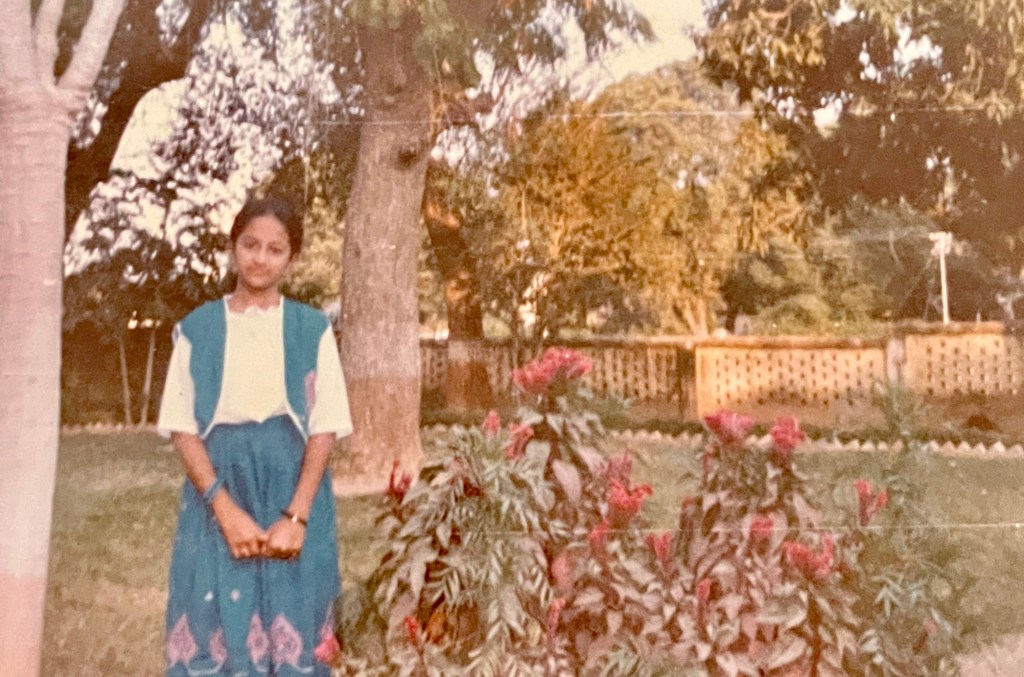
The clothes she gave away did not disappear. They dried papads on the terrace in the summer heat. They became the tiffin boxes we carried to school and the wok my mother made tamarind rice in on Sunday mornings. Half lives, my mother understood, are still lives. A dhoti does not stop being useful because it is no longer a dhoti.
I have tried to replicate this logic. It has not gone well.
There was a red dress. It was nice enough, unworn, taking up space. I discovered my skirt era around the same time I discovered an influencer who made upcycling look effortless, and around the same time I acquired a secondhand sewing machine. Emboldened by all three, I cut the dress in half. Top and bottom, separated. The bottom became a skirt. I wore the skirt once, to take a photograph, to post on Instagram. The top half is still somewhere in the wardrobe, belonging to nothing, useful to no one, waiting for a purpose that is not coming.
Would it have been better to donate the red dress as it was, intact, wearable? Yes. Did I instead destroy it in pursuit of a second life it did not want? Also yes.
The saris repurposed into tops, the dupattas transformed into shrugs and jackets, the various acts of upcycling creativity performed with great intention and an Instagram reel as a reference, all of them sitting unworn in their new forms, having given up their original forms for a second life that never arrived. My red dress became a photograph.
I think about this when I try to give things away and find I cannot do it cleanly.
The annual wardrobe purge is, I should say, a ritual available to a specific kind of life. You have to have accumulated something before you can agonise over it. And the giving away is its own problem. The charities that accept clothes have had to specify, explicitly, on their websites, that they would prefer the clothes to arrive washed and ironed. They have had to say this out loud, in writing, on the internet. Which tells you something about what usually arrives: things at the end of their useful life for the person giving them away, still warm from that person’s sense of virtue, not yet cold enough to be useful to anyone else.
I wonder, sometimes, if my Fab India kurtas are wearable in a context that is not mine, whether the block print and the handloom carry a signal about a particular kind of person with a particular kind of money that is not freely transferable. The nail lady has my kurta. I hope it is a gift and not a weight.
My mother would have known the difference before giving. She knew exactly what each sari was worth and to whom.
I think about her system often. I have not replicated it. I have instead built an app.
* * *
The app is called Wore-drobe.
I built it in 2025, in the great vibe coding era, when AI agents made it possible for people like me to build things we had no business building. Between the helpful agents that required servers and users like me building apps to track pointless overconsumption of clothes, god only knows how many gallons of water were wasted in the process. That particular episode of Black Mirror is for another essay.
To be fair to myself, one of the reasons I built it was genuine. I wanted to know my carbon footprint. I wanted to see, in numbers, what my choices actually cost, not just in rupees but in the other currency. It calculates cost per wear. It has mood-based tracking. It visualises consumption patterns to drive conscious consumption decisions. At the time of building it, I was approximately ninety percent certain that I would shortly be on Y Combinator.
The app has a dashboard. The dashboard has a Smart Insights section. The Smart Insights section has noticed some things.
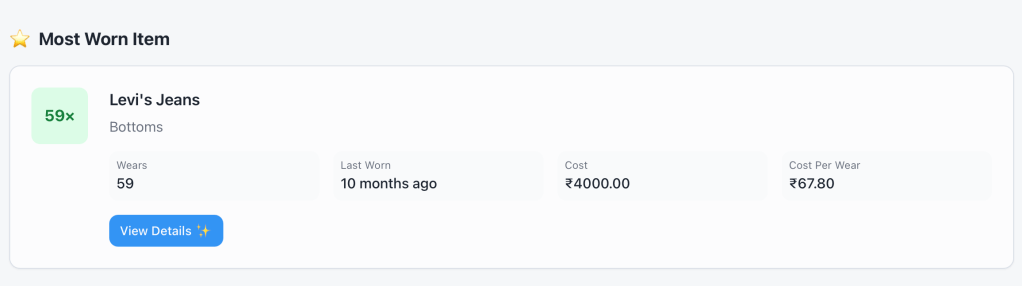
It has noticed that my most worn item is the Levi’s jeans: 59 wears, cost per wear of Rs. 67.80, last worn ten months ago. The jeans I swore would never leave have, quietly, also left. The app knows. The app is just being polite about it.
It has noticed that the Bengal Cotton Saree has not been worn in 428 days and would like to know: time for a comeback?
It has also noticed, and this is the one I cannot stop thinking about, that I have worn approximately 100% of my wardrobe recently.
The app thinks my wardrobe has 14 items in it. Because those are the items I entered. The app does not know about the other 186. It does not know about the eleven-tab spreadsheet, the blue silk dress waiting for a joy it already belongs to, the Jaipur kurta that is the only evidence a specific afternoon existed, the art that pokes, the green kurta bleeding quietly into everything it touches. The app is innocent. I built a tool for conscious consumption, told it about 14 of my 200 garments, and let it tell me I had worn 100% of my wardrobe recently.
The app is not wrong. The app is working exactly as designed. The app is just missing some context.
It is now live at wore-drobe.lovable.app, if you would like to track your own wardrobe. It will not judge you. It does not know enough to.
I should mention that while I was building an app to solve my own decision paralysis, the market was solving it differently. There are now several startups that will send someone to your home to organise your wardrobe for you. They come with label makers and vacuum bags and a calm professional manner. They sort things into piles. They make the decisions you cannot make. They leave you with a wardrobe that looks like the Instagram version of itself and a bill that is, presumably, worth it for the relief of not having to feel things about your clothes for an afternoon.
We have outsourced everything else: our groceries, our commutes, our meals, our therapy, our thinking, so it was only a matter of time before we outsourced this too. The decision of what to keep and what to release. The confrontation with the selves in the wardrobe. Someone else comes and does it for you, quickly, without attachment, without the weight of knowing what that blue kurta meant on that Tuesday.
My mother sorted her own clothes on an ordinary afternoon in a small town with a vessel seller at the gate. I built an app. The market sent a stranger with a label maker. We are all, in our own way, trying to make room.
I think about this for a while, sitting on my small corner of the bed, surrounded by two hundred pieces of fabric that represent, collectively, every version of myself I have been unwilling to release.
Because that is what this is, finally. Not hoarding. Not irresponsibility. Not the failure of a responsible consumer to follow through on her own systems. It is the inability to let go of selves.
They are all in here.
The girl whose mother sewed her frocks from fabric bought at Lajpat Nagar, who inherited an eye for colour before she knew what to do with it. The college student discovering that fashion could be a decision rather than a given, oscillating between M Block aspiration and Sarojini Nagar reality. The Fab India woman in her twenties, extremely pleased with herself, twinning with her curtains, washing her dupattas with L’Oreal shampoo because they were worth it. The field researcher who wanted her clothes to disappear, to absorb sweat and crowds and not upstage the room. The Bombay commuter nodding at a stranger on the local train who was wearing the same Westside Monday kurta, privately asking who wore it better, publicly not caring because it had pockets. The woman in her thirties who walked into a mall and discovered, in a fitting room, that she had been a jeans person all along and simply hadn’t known.
And the woman who bought a blue silk dress for the most significant Tuesday of her life, and is still waiting for a Tuesday significant enough to wear it. And the one who bought a polka dot sleeveless dress for a body she is still waiting for, like Godot, except Godot at least had the decency to be a metaphor.
You cannot purge these people. You can only pretend to, once a year, in March, with a spreadsheet and three motivations and the clean bright certainty that this year will be different.
In the end, I put almost everything back.
The art goes back. The blue dress goes back, still waiting. The jeans go back, to be inherited by nieces who will one day understand. The green kurta goes back, to bleed another day. The bad-event dress is already in the bin. The company t-shirt goes back in the wardrobe. Today feels like a Shah Rukh day. I put on the one with bade bade deshon mein across the chest. He has his arms open, as always. Chhoti chhoti baatein, he reminds me. Small things. He always comes through.
* * *
It is April now.
I got rid of one thing.
A maroon cotton dress. Not because I did not love it. Not because it no longer fit. Not because it failed any calculation on any of my eleven tabs. Because it was the only thing on the bed that was not ironed, and when the purge came, it had no alibi.
I did iron it first. Before giving it away. The charities ask you to. My mother would have known this without being told.
The wardrobe did not notice.
Next March, I will try again. The spring-summer collections will drop. Something will be in my saved-for-later cart. Something will need to change. I will open the doors, and two hundred garments will look back at me, and I will feel, briefly, the clean bright certainty that this year will be different.
It is a very good feeling. I recommend it.
I just would not put it in the spreadsheet.
Subscribe if you’d like to read more of my attempts to make sense of things through words.

 Primalsoup
Leave a comment