
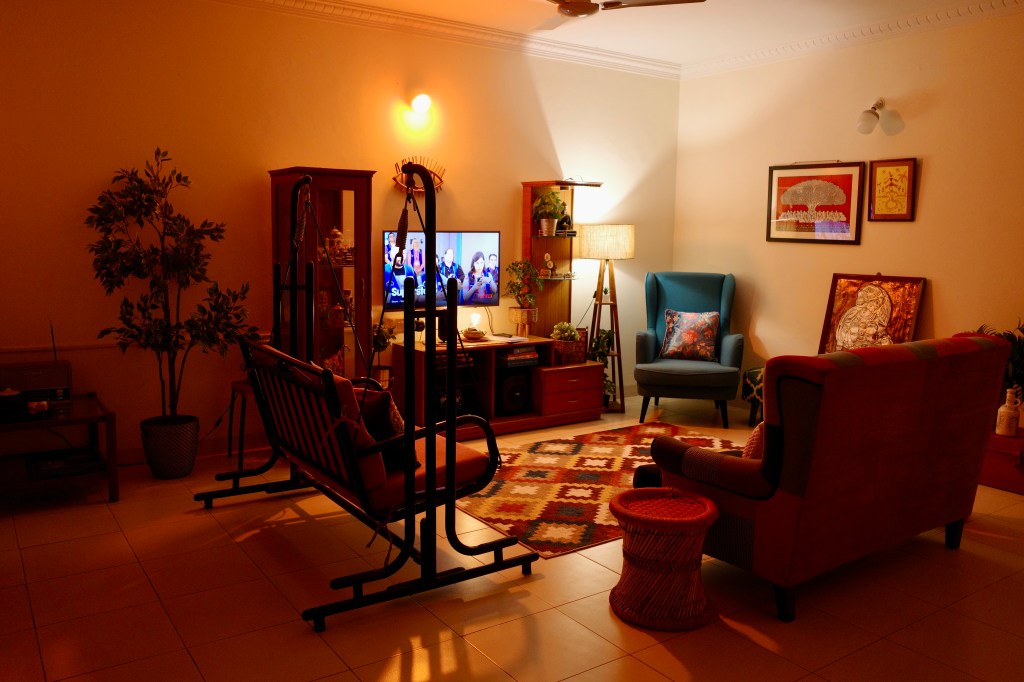
Life goes on. The TV is back on, even if something has shifted
Nobody tells objects. That’s the thing.
The package arrives at the door, scanned and sorted and dispatched through a chain of human effort so elaborate it borders on devotion, and it has no idea. The algorithm that predicted the purchase, the warehouse worker who pulled it off the shelf, the delivery person who photographed it on the doorstep, none of them got the memo. The system just keeps moving, the way systems do, indifferent and efficient and slightly terrifying.
I had been thinking about this for weeks, ever since I watched All the Empty Rooms on Netflix, a documentary about the bedrooms of children killed in school shootings in America, left mostly untouched by parents who cannot bring themselves to change anything. A tube of toothpaste, uncapped. Hair ties still looped around a doorknob. An outfit laid out for a school day that never came. A mother who hasn’t washed her son’s laundry in five years because the smell is the last thing left that is distinctly him.
These are rooms frozen at the moment of an impossible absence. Objects that didn’t get the memo either, but in a different register entirely. Not indifferent so much as bereft, still waiting, still pointing toward a child who should have had decades left to accumulate more things, make more orders, leave more evidence of a life in progress.
I watched it thinking about my mother. I watch most things about loss thinking about my mother. Five years ago, fifty-five days after she died, I made a short film. Just shots of my new home, a place she never lived in, but which still somehow carried her weight. I narrated it quietly, in one take. I called it Without Her. In it, I filmed the room I had filled with her things: her sewing machine, her books, her glasses, her talcum powder. I scrolled through her iPad. I followed her favourite artists. I tried to feel what she might have felt.
At the time I didn’t know what the video was. It wasn’t grief therapy. It was just something to do with my hands and my voice, at a time when language was failing and rituals felt hollow.
In the video, I used a word: malkosh. The Hebrew word for the last rain of the season. The thing about malkosh is that you only know it was the last rain in retrospect. While it is falling, it is just rain.
I thought about those rooms on Friday, when my uncle died.
He was a man who had strong opinions about democracy, pickles, footwear, and of course the Indian cricket team’s batting order. A few hours after the cremation, his replacement slippers showed up.
We talk about grief as if it arrives all at once. It doesn’t. It arrives in packages.
Sometimes literally.
He had ordered the first pair a month ago, decided they weren’t quite right, that particular post-purchase restlessness that comes for all of us around page three of the return policy, and placed a second order with the conviction of a man who intended to be around to wear them. The new ones arrived after the cremation. Someone carried them inside. Nobody knew what to do with them, so they set them down near the door, which felt both practical and unbearable.
He was 82. He lived well. And he died believing he needed better slippers. There is something in that I find more moving than I can explain.
When we got back from the crematorium, someone opened the package. We needed to do something absurd. Grief, when it is fresh and has no script, reaches for the ridiculous as a lifeline.
So we tried them on.
One by one, in that living room still rearranged from the morning’s rituals, the family auditioned the slippers. Both pairs. The new ones and the old ones, the ones he had found wanting. There was something faintly Cinderella about it, except the prince was gone and what remained was the glass slipper and a roomful of people who loved him, taking turns.
The son-in-law got the new pair. The nephew inherited the older ones, the pair my uncle had already judged and found lacking. As for the new ones, whether they were everything he had hoped for, whether he would have loved them or started a third order, we will never know. He took that verdict with him. Two men inheriting two pairs of slippers, and only one of those pairs comes with a review.
We laughed. It seemed crude. It was also the first time since morning that anyone breathed properly.
Then someone picked up his phone.
My cousin, my uncle’s younger daughter, found it ringing and answered it, and afterwards, in that particular lull that follows the practical chaos of a death, she opened his Favorites list.
Her older sister was there. She was not.
She was mock angry in the way you can only be mock angry when the real feelings are too large and too complicated and you have already cried everything you had that morning. It wasn’t about love, everyone in that room knew exactly how much he loved her. It was about the phone. The small, arbitrary cabinet of people he had decided, at some point, deserved one tap instead of two. The older sister had made the cut. The younger one had not. The algorithm of paternal affection, rendered visible and slightly absurd.
But the list had other entries. This is where it got interesting.
There was that one uncle. You know the one, every Indian family has him, the man who appears in everyone’s Favorites regardless of how the actual family tree is arranged. The connector, the one you call when something needs to be navigated. He was there, as expected.
There was the enterprising relative. Also expected. The person you turn to when something needs fixing, finding, sourcing, or quietly sorted. Present and accounted for.
And then there was the chemist.
Not a person’s name. The chemist store. Listed in Favorites with the same quiet dignity as the people who had wept at the cremation that morning. In India, the neighbourhood pharmacist occupies a particular role that no healthcare system has ever officially acknowledged: part doctor, part confessor, entirely indispensable. You call them with symptoms. They prescribe. Everyone understands this arrangement and no one speaks of it. My uncle had simply made it official.
(I recognised this immediately, because my own Favorites list contains my chemist. I am a champion self-medicator. The chemist is an improvement on me in this regard, less qualified than a doctor, but considerably more qualified than I am. He has been in my Favorites for years. I have never questioned this.)
We laughed the way you laugh when something is funny and true and a little devastating all at once.
Then my sister-in-law’s name came up. Nobody was surprised. She is the family’s Mrs Congeniality, the person everyone calls, everyone likes, everyone instinctively adds to their Favorites because she is the kind of person who picks up and actually helps. Her presence on the list was not a revelation. It was a confirmation.
But here is what happened next, in that living room, without anyone suggesting it: people started checking their own phones.
I checked mine too.
And there, in my Favorites, above the chemist and below a few others, is a contact I have not been able to change.
Amma.
My mother’s phone is mine now. Her number is mine. I have not been able to rename the contact from Amma to Radhika Other or Radhika Android or anything that would make it accurate. So it stays as Amma, even though when I call that number, I am the one who picks up.
I use her phone for the odd jobs of a digital life. If an unknown number calls me, I block it on my “real” phone and call back from hers. I transfer documents between the two phones constantly, she was an Android person and I have an iPhone, and approximately ten percent of my life is spent making these two worlds talk to each other. Apple cloud, like most things Apple, is overpriced, so I run a Google subscription and dispatch things between the phones to make room for new accumulations. It is an entirely practical arrangement. It is also the most intimate thing I do every day.
And sometimes, when I cannot find my real phone, I call my number from hers.
I know I am the one calling. I know that when I pick up, it will just be me, transferring myself across the gap. But when my phone lights up and I see Amma on the screen, I am startled every time. Every single time. The body knows something the mind has already processed. Or maybe the mind knows too, and is just grateful for the one second before it does.
This is where malkosh comes back to me.
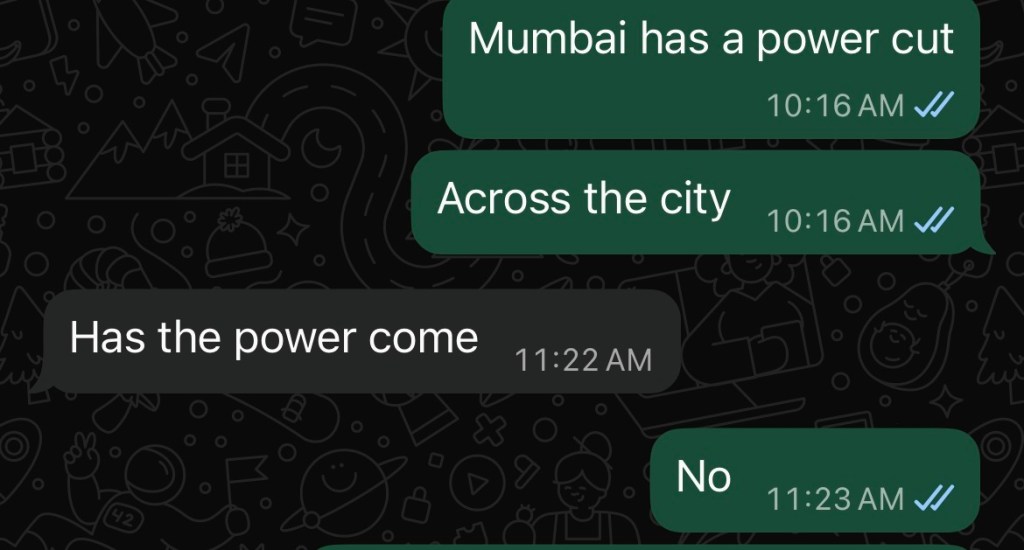
The last text exchange I had with my mother was about a power cut. I was in Mumbai. I told her: Mumbai has a power cut. Across the city. An hour later, she asked: has the power come. I said: no.
That was it. That was the last exchange. Not I love you. Not something I could frame and keep. Just a mundane dispatch about infrastructure, the kind of text we sent each other a dozen times a week, unremarkable in every way except that it was the last one and neither of us knew.
She was the one who followed up. She checked in, the way she always did. I just answered.
It was just rain.
My uncle’s Favorites list is a record of his malkosh moments, even if he never thought of it that way. The last time he needed the chemist. The last time he called the fixer. The last order he placed, with the full expectation of receiving it.
A Favorites list, it turns out, is less a list of your favourite people and more a record of your needs. It is biographical in the way that medicine cabinets are biographical, or search histories, or the particular items you keep meaning to throw away and don’t. It doesn’t show who you love. It shows who you reach for.
My uncle’s list showed a man navigating the ordinary emergencies of being alive: a body that needed managing, problems that needed solving, people who picked up. It was not a map of his heart. It was a map of his life as it was actually lived, in the small panicked and practical moments that don’t make it into eulogies.
This is what objects do, when we are gone. They don’t grieve. They don’t soften the edges. They just sit there, being honest.
The slippers say: he was still hoping. The phone says: here is who he actually called. The sewing machine says: she made this look easy. The talcum powder says: she was here, and then she wasn’t, and the smell is still faintly in the lid if you open it on the right day. The contact that still flashes as Amma says: some things you leave exactly as they are, because changing them would be a kind of lie.
None of them is the version of someone we will tell at the dinner table in ten years. All of them are true.
My cousin, the younger daughter, is still mock angry about the Favorites list. She will probably stay mock angry for years, which is its own kind of tenderness, the joke that becomes the way you carry someone.
As we all checked our phones that evening, I suspect some people quietly rearranged things. I’m not saying I did.
Every phone will eventually be picked up by someone else, its Favorites list read like a small, unsentimental autobiography. Every room is eventually that room. Every order is potentially the last one, dispatched with the quiet confidence of a person who fully expects to receive it.
The best you can hope for, I think, is that the chemist makes the cut. It means you were paying attention. It means you knew who actually showed up.
And maybe, in the end, that you had ordered the right slippers. Or were still trying.
The rain doesn’t know it’s the last rain. That’s the whole point. That’s also, somehow, the comfort.
Subscribe if you’d like to read more of my attempts to make sense of things through words.

 Primalsoup
Leave a comment