
Some years back, when I was in a Rumi phase, because who wasn’t, I used to quote: Out beyond ideas of wrongdoing and rightdoing, there is a field, I’ll meet you there. I said it like I’d discovered it. I said it like it was mine.
Fifteen years ago, quoting Rumi was already cliché. But it was an intentional cliché. I had copied those lines into a folder on my hard drive called Borrowed Words. If someone else had articulated your feeling better than you ever could, why reinvent the wheel? The folder was my philosophy: you are what you reach for.
And I reached for everything.
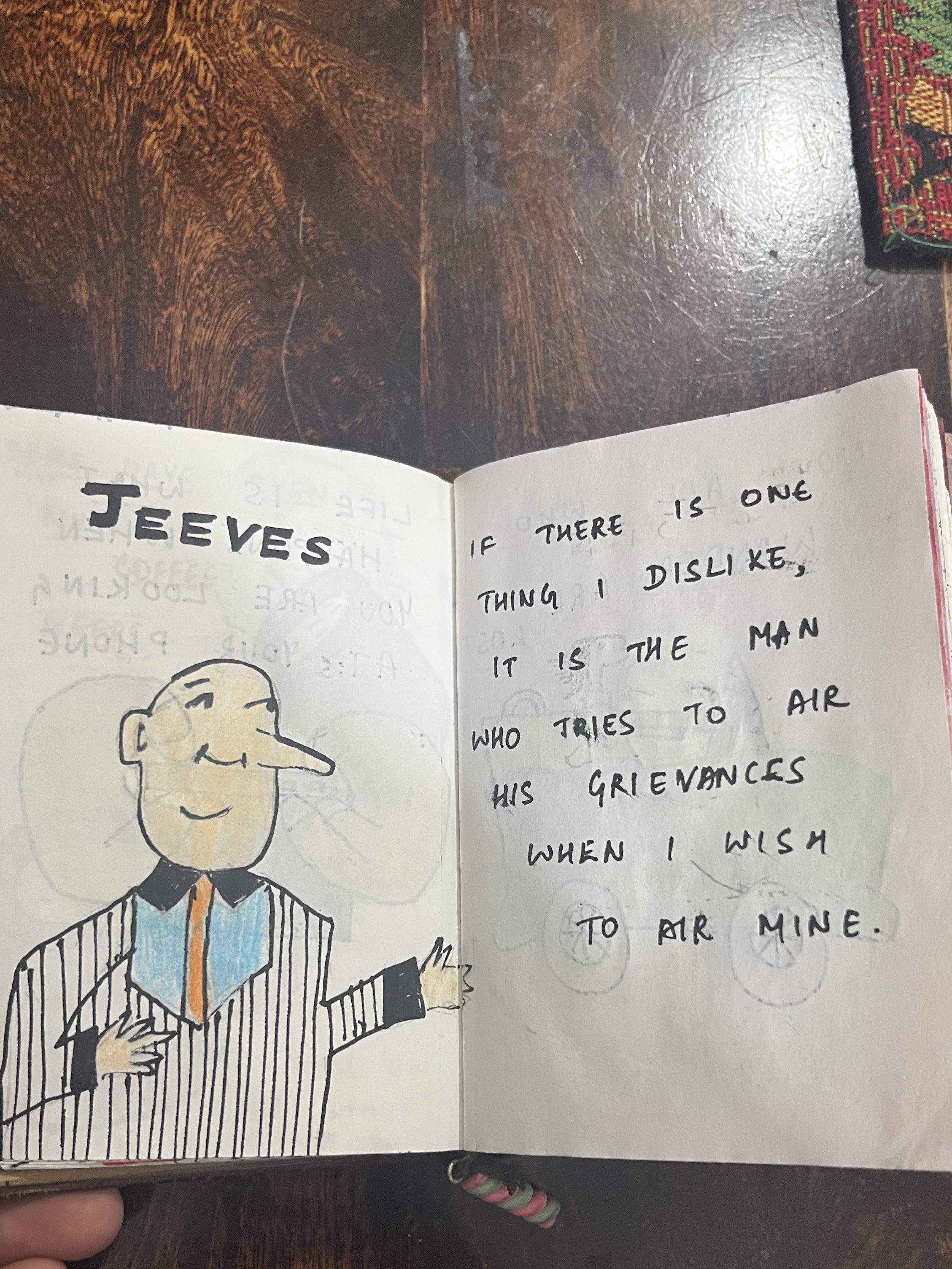
There was Tolkien, quoted extensively and almost always out of context. Not all who wander are lost, deployed at various points to justify a bad decision, a career pivot, and once, a truly questionable holiday. There was Dumbledore dispensing wisdom to Harry, which I stand by completely. There was Jhumpa Lahiri, Rushdie, Amitav Ghosh, and Arundhati Roy, her line about great stories still lives in me like a splinter. There was the epigraph from The Brief Wondrous Life of Oscar Wao, which I loved partly for the novel and partly because caring about epigraphs felt like evidence of a serious mind. There was Gulzar and AK Ramanujan, at one point I was obsessed with the phrase red earth and pouring rain. There was Vikram Seth’s poetry, because he was celebrated as a novelist, but I knew he was really a poet, and knowing that felt like a secret worth keeping. There were words in Urdu and Tamil. There were Bollywood dialogues, obviously Shah Rukh, because some of us were raised as devotees. There was Calvin and Hobbes. There were magazine clippings, sometimes an image, sometimes a line that felt devastatingly clever at 2 a.m. If you think everyone around you is the asshole, probably you are the asshole. That kind of thing. The folder had a physical life too, journals, notebooks, a hand-drawn Jeeves dispensing Wodehouse with the gravity of a man who had earned his opinions.
This was not a collection. It was a self-portrait.
If I’m honest, the folder was already a little algorithmic. Tolkien led to Dumbledore led to Rushdie, who led to Roy, who led to Díaz, taste is always cumulative, always borrowed from somewhere. I was never operating outside the system. But I was moving through it slowly, with a body, with embarrassment, with the friction of actually having to find things, type them out, save them, return to them later and decide they still fit. The folder had a curatorial logic that was entirely mine. Not everything got in. That exclusion, that no, not this, is where taste actually lives.
“Blair Waldorf” – and I invoke her with full seriousness, was once called an evil dictator of taste. In Gossip Girl, she is the girl who decides what is worn, what is said, who is in and who is catastrophically out, enforcing these decisions with the quiet ferocity of someone who has never once doubted her own judgment. Dan Humphrey meant it as an insult. I have always received it as a compliment. Taste requires you to rule something. To say this yes, that no. To enforce standards with, if necessary, monarchical ruthlessness. My Borrowed Words folder was my Upper East Side.
The difference between Blair Waldorf and an algorithm is simple: Blair had veto power. The algorithm has distribution power. One creates taste. The other dissolves it.
Now I say liminal space. And a mere seconds after I say that phrase, I feel like I have had an out of body experience. Liminal space? Really? I can promise you that nobody who knew me prior to 2025 had ever heard me use that phrase.
Somewhere between Rumi’s field and the red dot on my Slack icon, the soul of a poet has been quietly replaced with something optimized. And yes, quoting Rumi was embarrassing. But it was curated embarrassment. I chose my metaphors. Now the metaphors arrive pre-assembled, distributed simultaneously to everyone, frictionless, authorless, fingerprint-free. They are language engineered to signal depth without the inconvenience of having one.
I sit in meetings now where someone will say we need to scaffold this, and I will nod, and I will wonder when scaffolding stopped being something you put around a building under construction and became something you did to a content strategy. I can usually tell when something has been AI-assisted, and honestly, I’m not even mad about it. Language has been democratized and who am I to stand at the gate with a clipboard. What gets me is the laziness that comes with it. The word salad arranged to resemble an argument. The ‘but here is the thing’ deployed where an actual thing should be. The rhetorical scaffolding with nothing inside it. Yes, I said scaffolding. Is that a problem?
But the thing I find hardest to admit, and I say this as someone who studies exactly this phenomenon professionally, which means I have absolutely no excuse, is what happened to my own vocabulary.
For years, as a qualitative researcher, I used the word delve constantly. I was delving into insights. I was delving into consumer behavior. On particularly ambitious days I was both delving and deep-diving simultaneously, which is a level of immersive commitment I stand behind entirely. Delve was mine. I had earned it through years of fieldwork and late nights and reports nobody read until the third slide.
Now I cannot use it.
If I write delve in anything, I stop and ask myself: will someone think a machine wrote this? Will my years of actual delving be mistaken for autocomplete? I have become a writer who edits herself not for clarity or style but for the appearance of humanity. I am revising my own vocabulary to prove I still have one. A recent study confirmed what I already suspected in my bones, ChatGPT has made delve its signature word, and humans are now saying it back in podcasts and conversations, even when they’ve never touched the tool. We taught the machine to talk. The machine is teaching us. Nobody is quite sure where the loop begins anymore.
I study this professionally. I notice liminal space arriving in my own mouth approximately three seconds after I’ve said it. The researcher is not outside the experiment. She is, in fact, Exhibit A.
Taste, real taste, is an act of resistance. Not nostalgia, resistance. It requires you to move slowly through language, to let some of it in and keep most of it out. It requires friction. It requires veto power. It requires, occasionally, the willingness to be the only person in the room who finds scaffolding a deeply suspicious word.
I still have the hard drive. When the slop gets to be too much, and it does get to be too much, I go back to it. Tolkien. Arundhati. Gulzar. Shah Rukh. Calvin and Hobbes. A self I assembled slowly, with effort and embarrassment and taste. The folder is my totem. I touch it and remember what it felt like to choose a word because I meant it, not because it arrived pre-approved.
Recently I started a new Borrowed Words folder. On my iPhone Notes app, because the hard drive is in a box somewhere and also it is 2026. One entry so far:
When the axe enters the forest, the trees whisper to each other: “The handle is one of us.”
Seemed like a perfect allegory of the times we live in. Or not. Full disclosure, I discovered the quote via my For You page on Instagram. The algorithm, well, the force is strong, what can I say.
But net-net, the folder is still there. The cloud doesn’t know about it.
And yes, the world is too full to talk about.
And that field, I will meet you there.
Subscribe if you’d like to read more of my attempts to make sense of things through words.

 Primalsoup
Leave a comment