
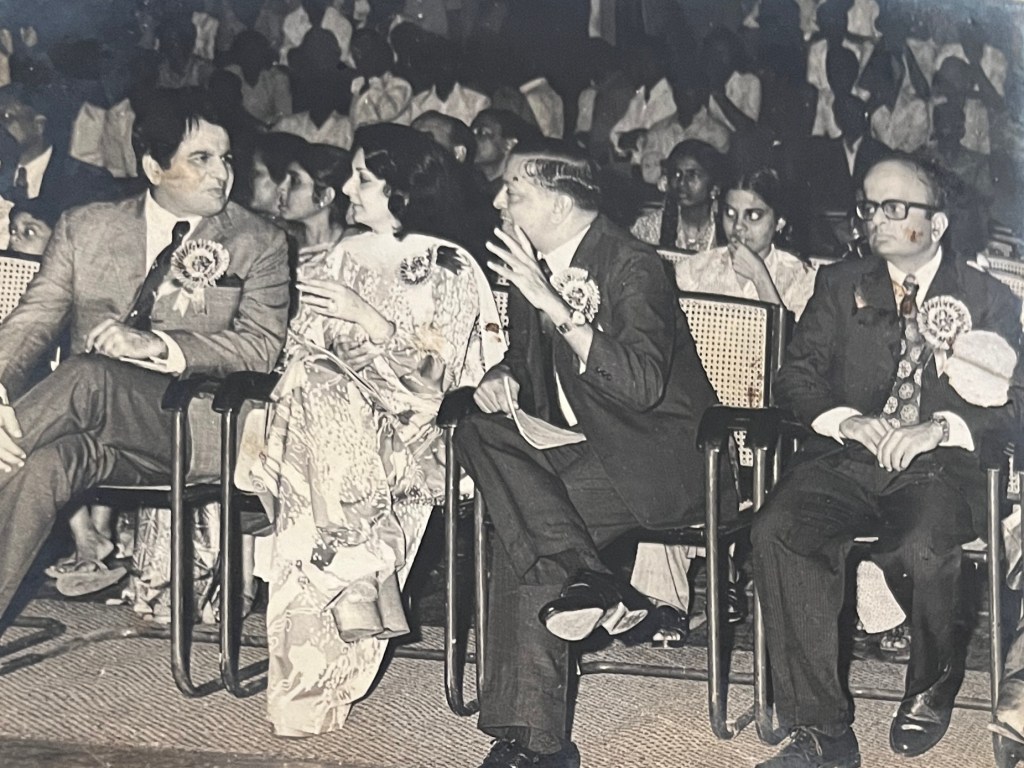
The annual pre-Independence Day office party. The night before I was born. Dilip Kumar and Saira Banu in the front row, with Appa. My name almost decided.
I know, I know. What’s in a name? is the most overworked question in the history of questions. Shakespeare asked it, your motivational calendar asked it, and now I am asking it, except I have opinions and I am not going to stop until I have shared all of them.
Names are destiny. Names are data. Names tell you, with reasonable accuracy, what year a child was born, what her parents were hoping for, and how she will fare in the alphabetical lottery of school roll calls.
Consider: if your parents named you Aabha, you were roll number 1 your entire academic life. You handed in assignments first. Teachers learned your name on day one. You were either a prodigy or a nervous wreck, there was no middle ground. If they named you Zubin, you spent twelve years waiting. You got used to it. Probably developed excellent patience and a talent for staring at the ceiling.
This is not a small thing. Your parents made this choice for you. You will love them or resent them for it, and either way, it will be too late.
Names are also cyclical, which is to say, names are mirrors held up to whoever Indians were collectively besotted with at a particular moment in time. The year 1994 produced a bumper crop of girls named Aishwarya and Sushmita, for obvious reasons, given that India won both Miss World and Miss Universe that year and every parent with a daughter felt the universe was sending them a sign. Bollywood has always been a reliable naming oracle. Cricket, occasionally. And if this Fifty Two piece on the Sanjana boom tells us anything, an entire generation of girls named after Aishwarya Rai’s character in the Pepsi ad, it is that we are all, at some level, naming our children after our crushes.
The mythology of Aishwarya Rai is, of course, something else entirely. There is this wonderful Granta short story by Sanjana Thakur (how lovely that she is named Sanjana!), winner of the Commonwealth Short Story Prize, in which the narrator is a girl named Avni who searches a shelter for a new mother, specifically one who resembles Aishwarya Rai. It is satirical and reversed and quietly devastating, and it tells you everything about what that face, that name, that particular idea of beauty came to mean to a generation of Indians. We did not just name our daughters after her, rather we built an entire architecture of longing around her.
My parents named me Radhika.
Here is how that happened. The night before my mother went into labour, my parents attended my father’s office party, the annual pre-Independence Day tradition where a Bollywood celebrity was invited to grace the proceedings. The year I was born, it was Dilip Kumar and Saira Banu. Had I been a boy, I would almost certainly have been Dilip. I am confident of this. As for Saira, well, even my progressive parents would have hesitated. To name a daughter after a Muslim actress, in that decade, in that milieu, would have been a statement they were not quite ready to make. They were progressive in the way that many Indians of that generation were progressive: genuinely, but within limits that were never quite examined out loud. A name carries a religion, a community, sometimes a political position. You do not always choose it consciously. Sometimes it chooses you by default.
In my culture, children are typically named after grandparents. But I was the third child, and by the time you are on your third, the naming rules have softened into suggestions. My father’s boss and mentor had proposed Anuradha, which was, by all accounts, the name of his own former crush. My parents considered it but ultimately did not want to burden me with the name of some random adult man’s romantic history. Instead, they ran with the Radha from Anuradha and made me Radhika. My father, a lifelong Rafi devotee, had always loved Madhuban mein Radhika naache, a song that came out two decades before I was born, so this was hardly a recent inspiration. And here is the detail that pleases me most: that song was sung on screen by none other than Dilip Kumar. The man who nearly became my name came back anyway, through a Mohammed Rafi song, and gave me mine. As an aside, Dilip Kumar’ name was actually Yusuf Khan. My parents, who had hesitated to name me after Saira Banu, had no such hesitation about the name Dilip. Some contradictions, it seems, were never examined out loud.
For the record: I do not dance. I have two left feet and no ambitions to remedy this. Sorry, Appa.
Radhika, I came to understand, is a name that neither threatens nor promises. In the roll call, I sat comfortably in the middle, somewhere in the crowded democracy of Ms, Ns, Rs and Ss, watching the Aabhas finish early and the Zubins philosophically wait. Radhika was pleasant. Radhika was manageable. Radhika did not walk into a room making claims. Not as common as Pooja, Seema or Neha, but not as uncommon as Samyukta either. In every grade there was at least one other Radhika, who as luck would have it was the exact opposite of me: prettier, smarter, good at dancing. You get the drift. There was no weight of a name to live up to or spectacularly fail. Imagine if they had named me Sangamithra. Or worse, after a raga, Nilambari, say. The pressure alone. For what it is worth, every Radhika I ever met went on to become a friend. So no therapy needed there.
There is one famous Radhika, the South Indian actress, successful but in an understated way. She comes across as a no-nonsense sort, and to my knowledge, unlike some of her peers, has no temples built in her honour. It is not a name parents give their children much anymore. Except, interestingly, for the younger Ambani daughter-in-law, which I find genuinely fascinating. To be a Radhika in that family, surrounded by women named Nita and Isha and Shloka, names that arrive already dressed for ambition, is to carry a different kind of charge entirely. What does it mean to negotiate immense wealth and scrutiny behind a name that has always been coded as pleasant, approachable, a little ordinary? Maybe it is armour. Maybe it is freedom. I find myself rooting for her in a way I cannot entirely explain. Though rooting for a billionaire is a bad look. I also understand.
At Starbucks, my name comes back to me as Radhika, or Ravika, or Rahika, or on inspired days, Radical. If only they knew. I am deeply, constitutionally, almost professionally un-radical. But I appreciate the ambition.
Would we ever see a Bollywood heroine named Radhika? Not a chance. And Bollywood, it turns out, has always known this. Like many Indian Gen X women, falling in love with SRK was a rite of passage. Mine happened not via a Raj or a Rahul, but through the more humble Sunil, the character he played in Kabhi Haan Kabhi Naa, before the Raj-Rahul-Rohit industrial complex fully took hold. Sunil was sweet, slightly bumbling, entirely loveable, and I became a devoted SRK follower on his account. The name has quietly retired in certain circles at least, the way certain words do, still understood but no longer in use. SRK understood this instinctively: he shed Sunil for a series of upper-caste Punjabi Hindu heroes with names that signalled aspiration, romance, arrival. Raj. Rahul. Rohit. The country was rebranding and so was he. The one time he stepped back from all that and became Mohan, in Swades, a plain name for a plain man coming home, it was the finest thing he ever did. The box office disagreed. The box office usually does, when someone tells the truth.
Radhika, meanwhile, remains the random friend. The one who gives good advice in scene three and is never seen again. (Though sometimes she at least lets the movie pass the Bechdel test.) There is, I have decided, a quiet freedom in this.
As someone who does not have children of her own, I received the greatest possible gift when my brother and SIL allowed me to name both their daughters. I treated this with the gravity it deserved, which is to say, I named the first one after a girl I barely remember from grade two.
Her name was Meghana. I have only the vaguest memory of her, she had a pencil pouch. Not a plastic Mickey Mouse box like mine, but a pencil pouch, the kind that zipped, and inside it she had an eraser shaped like a sunflower, and vast quantities of shiny hair, and a confidence I could not name at seven but can now identify as the particular ease of a girl who has already figured something out. I desperately wanted to be her best friend. This did not come to pass.
I am happy to report that my niece Meghana, now nearly a young woman, does possess vast quantities of shiny hair, with hidden blonde streaks that her mother may or may not be aware of. The sunflower eraser has not yet made an appearance, but I remain hopeful.
A few years later came the second daughter, and with the second child, as every second child knows, there are conditions. She had to rhyme, or at least harmonise, with Meghana. This is the cross the second child bears, and I say this as someone who was third and therefore escaped the rhyming requirement entirely by virtue of parental exhaustion. Anjana, Sanjana, Nilanjana were all considered. I settled on Niranjana.
Niranjana has a great many opinions. I have no doubt that one day she will write an essay about the aunt who saddled her with a name containing more syllables than is strictly reasonable. To both these young women I want to say: you are welcome. Meghana and Niranjana are strong names. They are names of people who will accomplish something in life, not cure cancer, necessarily, but at the very least become a Brand Manager, maybe a Creative Director if the economy cooperates. They sit in the middle of roll calls, as God intended, learning from the mistakes of the six Ananyas ahead of them.
Then there are names that are simply attractive. Names that arrive pre-loaded with a quality, a certain light. For my generation, that name was Kabir. And when I say my generation, I mean a sample size of one. Just me.
I did not personally know any Kabir. I encountered my first one when I read A Suitable Boy the summer after my board exams, before college. I took deep and immediate exception to Lata for not ending up with Kabir Durrani. I was so convinced of his suitability that when I went for my St. Stephen’s interview and the professor asked what the last book I had read was, I said A Suitable Boy. Truthfully, and also knowing full well it would be impressive. When he asked who I thought the suitable boy was, I said Kabir, as if on autopilot.
The professor informed me, gently but firmly, that Haresh Khanna, who was himself a Stephanian, was probably the suitable boy. I did not get into St. Stephen’s. I choose to believe these events are unrelated.
Years later, when the TV adaptation was announced, everyone wanted to know which Bollywood A-lister would play Lata Mehra. I wanted to know who they would cast as Kabir. I had lobbied internally, to no one, for Fawad Khan. Alas, some dreams are not to be. Though for what it is worth, I approved of the floppy-haired waif they did cast. I watched the entire series quietly hoping that the Netflix gods might intervene and change the ending. They did not. It is like rereading Little Women and hoping Beth will not die. Hope springs, disappointingly, eternal.
And here, a moment of silence, please, for all the Kabirs I never met. The ones I firmly believed were the avocado to my sourdough.
In all of my sweeping generalizations, there are the edge cases. There is the matter of my neighbour’s daughter.
A Gen Z couple, my neighbours, have given their daughter the name Milli. Which made me smile. Milli does not begin with A. It is not a portmanteau of the parents’ own names. It has no faintly euro-centric twang to it, nor is it straight out of the Vedas. It belongs to another era entirely, to Doordarshan evenings and the particular quality of light that came through the television screen in the eighties.
There was a film called Milli, and Jaya Bachchan played her. The story goes that she was named so because she was always slipping away, always getting lost, and the question that followed her everywhere was Milli? meaning, has she been found. I loved that story. A name born from anxiety, from the relief of being recovered. Milli had leukemia. But unlike SRK’s Aman in Kal Ho Naa Ho, who died beautifully and to great sadness, and unlike dear Beth in Little Women, Milli’s film ends with her and her beau flying away for treatment somewhere hopeful and far. An ambiguous ending. An open door rather than a closed one.
Many years later, when the doctor handed me my own cancer diagnosis, I did not think of Aman Mathur. I thought of Milli. I chose her ending over his, her story over his, her name over his. Some names, it turns out, are not just what we are called. They are what we decide to be.
Some names carry their destiny visibly, the way a weather forecast carries the weight of what is coming. A classmate from school was named Leher, wave, in Hindi. A name with movement in it, with lightness. You could tell just from the name that she would be clever and pretty both, that she would move through rooms easily. She went on to become a great journalist. Also a Miss India. Wot. I cannot say I was surprised.
My admin colleague at my first job was named Kartyayani, one of the forms of the goddess Durga, fierce and protective and not to be trifled with. You expect a name like that to carry weight, to have opinions, to be simultaneously kind and immovable. She was, on all counts. Names can do that. Sometimes they grow the person into themselves.
But sometimes names are taken away, not through accident or whim, but through the slow erosion of being seen as a function rather than a person.
A few years ago, Swiggy ran a lovely ad about exactly this, a delivery boy who moves through his entire life being called Swiggy. Childhood birthday parties, school, adulthood, all of it. His seventh birthday cake said: Happy Birthday Swiggy.The campaign dialled up the absurdity on purpose, but the absurdity was always the point. The app tells me that Satyendra is on his way to my house as quickly as possible. It tells me that my Uber driver Ravi is great with conversations. The names are right there, offered to us, and we still mostly do not use them. I know that I am bad at this. I know it, and I am telling you about it because knowing and doing are different rooms and I am still finding the door between them.
My name was chosen the way most things in my life have been chosen: adjacent to a plan, shaped by accident, settled by a song. Madhuban mein Radhika naache. Mohammed Rafi. All India Radio, my father standing in front of a mirror smoothing Brylcreem into his hair, not yet knowing he would one day have a daughter to name.
I did not dance. I did not make it to St. Stephen’s. I did not meet any Kabirs. I named one niece after a half-remembered girl with a pencil pouch and another after a word I kept turning over until it felt right, and I will hear about the syllable count for the rest of my life, probably.
But I am, at Starbucks, occasionally Radical. And somewhere out there, Satyendra is on his way, and I am going to try, this time, to say his name when he arrives. And when things get hard, I think of a girl who kept slipping away and being found, and I choose her story.
That seems, on reflection, like enough.
Subscribe if you’d like to read more of my attempts to make sense of things through words.

 Primalsoup
Leave a comment