
Or, how I found the perfect quote to open my novel, without actually writing the novel
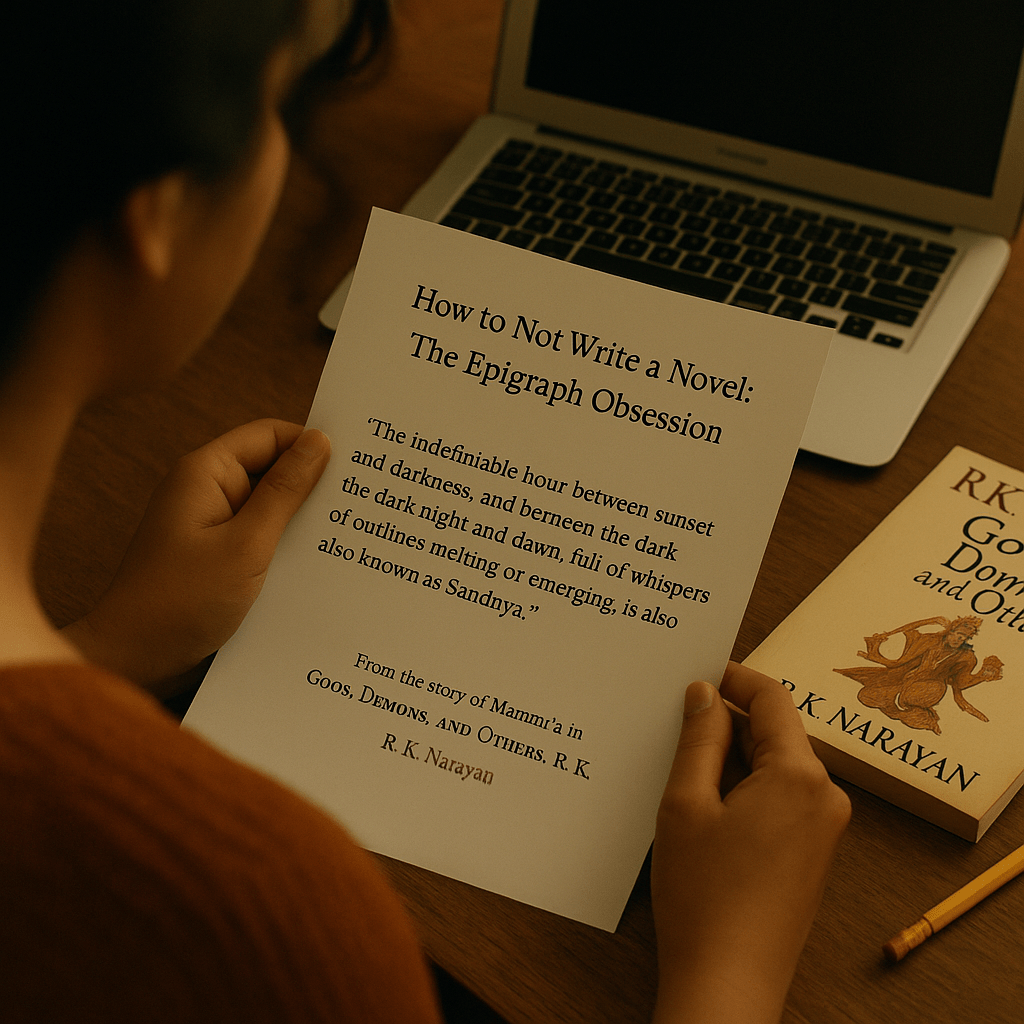
[Representative Image generated using AI]
At some point in the last few years, somewhere between revising Chapter One for the fifth time and deleting Chapter Two altogether, I decided what my novel really needed was not more plot, or character, or forward movement.
It needed an epigraph.
Because if the actual story was missing, at least the opening line, someone else’s line, could carry the weight of meaning I had not yet earned.
So I began collecting quotes.
From novels, essays, obscure poems. From literary giants and Instagram poets with suspiciously good lighting.
From Rumi, because obviously. From Tagore, because emotional accessibility is important. From Susan Sontag, who at this point deserves co-author credit on my entire personality.
Every quote felt like it could be the one.
Until it wasn’t.
Because here’s the thing:
When people buy books, they look at the cover, the plot synopsis, the blurbs, even the ‘praise for the book’ section by other prominent authors.
(Personally, anything described as a “tour de force” is an immediate dealbreaker for me.)
I, on the other hand, open the book and flip straight to the epigraph.
(And now that I’m older, also to check the font size, but we’ll talk about that another time.)
To me, the epigraph tells me more about the writer than the book.
Because, let’s face it, the epigraph is often unrelated to the plot.
The connection is tenuous at best, pretentiously overreaching at worst.
But the epigraph is a signal of taste, ambition, and, most importantly, a hidden common friend between the writer and the reader.
It says: we know the same songs.
We wandered the same hallways.
Maybe, just maybe, we understand each other a little already.
Which is why I treated choosing mine like sacred work.
I once read a book review that described a young author as “the Jane Austen of Kolkata.”
Another said, “If R.K. Narayan’s Malgudi were transported to the Elizabethan era, this would be the novel that resulted.”
Yet another compared a slim, contemporary novella to Tolstoy, as if War and Peace could be condensed into 143 pages and a minimalist cover with a single gulmohar petal on it.
You get the drift.
Literary comparisons are less about precision and more about aspiration.
They are not saying, “This is the next Toni Morrison.”
They are saying, “If you squint sideways, there is a whiff of Morrison.”
And I love it.
I believe books are spiritual successors to worlds we have already lived in.
In that sense, every novel deserves a stunning callback to some Great Work, even if the connection is an afterthought.
While I am not an ambitious person (I am pathologically humble, deeply suspicious of praise, and often forget to iron my clothes), but I have always had enormous ambition for my novel.
Which is why I spent far too long agonising over the epigraph.
Should I go Orwell, something about truth and lies and writing in dark times?
Should I start with Anna Karenina and update it to Let them eat vada?
Should I quote an obscure Soviet poet I have never actually read but emotionally relate to?
I made a list.
Some quotes were philosophical.
Some lyrical.
One was from a K-drama.
Another was from the Thirukkural, which I considered leaving untranslated, to let readers marinate in confusion and grant me undeserved literary street cred.
At some point, I genuinely wondered:
What comes first – the story, or the epigraph?
Because the story was slippery, shifting, missing entire parts.
But the epigraph was perfect.
Complete.
A single, chosen sentence that carried all the ambition I could not bring myself to write.
Eventually, I narrowed it down to three possible epigraphs:
R.K. Narayan, because I loved the quiet smallness of the worlds he built.
I didn’t grow up in Malgudi, but I grew up in houses where ceiling fans made more noise than family members.
Jane Austen, because emotionally unavailable men basically wrote my dating history in my twenties.
Quoting her would be honesty, not homage.
And Kalki, before Mani Ratnam made him pop-culture official.
Back when quoting Ponniyin Selvan meant you had actual literary street cred and not just a Pinterest board.
Each choice was deliberate. Each one meaningful.
And none of them, absolutely none, appeared in the manuscript.
Because the manuscript did not exist.
But eventually, I chose this:
“The indefinable hour between sunset and darkness, and between the dark night and dawn, full of whispers and suggestions, of outlines melting or emerging, is also known as Sandhya.”
— From the story of Manmata, Gods, Demons, and Others, R.K. Narayan
A line with absolutely no connection to my story.
But something about it, the feeling of being suspended between worlds, between endings and beginnings, felt right.
It felt like the version of the novel I wanted to write, even if I hadn’t written it yet.
Halfway into Chapter Two, I changed my protagonist’s name to Sandhya, because why not.
It sounded lyrical. Mysterious.
It sounded like it belonged to a better novel, one that already existed.
I then spent an entire afternoon scratching out and renaming my character across 350 Post-its, index cards, and Notion tabs.
At the end of it, I looked around.
The story was still missing.
The character was still forming.
But the name was there. The quote was there.
A scaffolding of meaning, waiting for the house to be built.
And that, dear readers, is reason no. 127862822 for how not to write a novel—because sometimes, you choose the epigraph first, and hope the novel finds its way toward it.

 Primalsoup
Leave a comment