
Or, how I spent three months curating a literary identity for a book that doesn’t exist
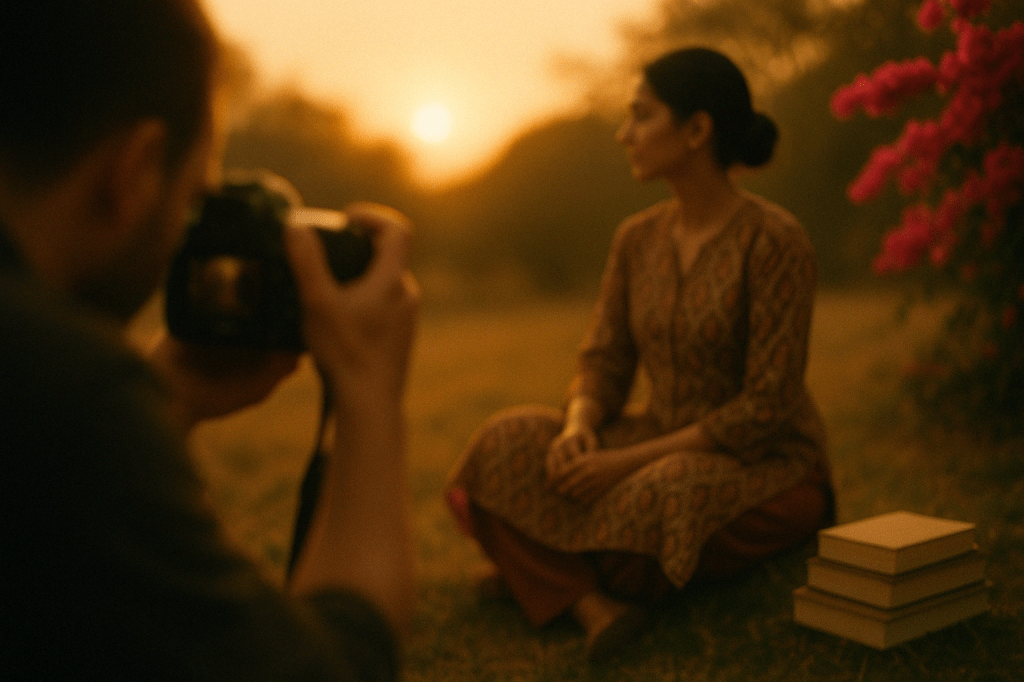
[Representative Image generated using AI]
You know what’s really important when writing a novel?
No, not plot.
Not character arcs.
Not even finishing the draft.
It’s the author photo.
Because at some point during your fifth writing spiral and fourth abandoned outline, your brain says, “What will they put on the back flap of the book I haven’t written?”
And so it begins.
You tell yourself it’s harmless. Just a few reference images. Maybe a Pinterest board titled serious but whimsical. You search for “literary author portrait,” and suddenly you’re looking at Jhumpa Lahiri in monochrome, Arundhati Roy backlit by meaning, and someone in a turtleneck whose cheekbones have clearly published a prizewinning short story collection.
You begin to notice a pattern.
Why do women writers all look like they’ve just returned from a silent retreat in a coastal European village where they fell in love with language, linen, and someone who brews pour-over coffee with emotional intensity?
Why do their cheekbones catch the light like they’ve absorbed metaphor?
Why does their expression say, “I cry, but only in lowercase”?
Meanwhile, I seem to have been born without a jawline or cheekbones.
Which is strange, considering I was born to a set of parents who had both, sturdy jawlines, defined cheekbones, the whole package.
The genetics are there. They just skipped me.
Possibly because I chose the arts.
You know what I did get?
Diabetes.
And painful knees.
The genetic lottery. Thanks for playing.
Still, I believe in effort. So I try to manifest my cheekbones.
I watch Instagram videos with suspicious commitment, rolling cold jade stones across my face like I’m polishing a monument to literary insecurity.
I stick them in the freezer. I follow the arrows. I believe.
But influencers are a scam.
Nothing appears except mild redness and the creeping realisation that sculpted bone structure is not my destiny.
Eventually, I decide it’s time. I need an author photo. I need to look like someone who has written something, even if I haven’t. I don’t have the money to hire a professional, obviously, because what I do have is a Google Doc titled Final Draft – NO REALLY FINAL and a personal budget that prioritises paneer over portraits.
So of course, I find that one friend.
You know the one.
The person who bought a DSLR in 2010, during the peak of the moody hibiscus flower photography era. The one who used to upload sepia-filtered close-ups of bicycle wheels and caption them with song lyrics.
They had a Flickr account.
Remember Flickr?
Back when we curated moody diptychs and watermark fonts were a personality?
This friend was a full-blown aesthetic. They once did an entire series on shadows and dried leaves and called it “Stillness.”
Now they work in logistics.
But the DSLR still exists, somewhere in the back of their cupboard, along with a tripod, a lens cloth, and possibly their dreams.
They agree.
Reluctantly.
They dust the lens. Find the charger. The shoot is on.
You meet late afternoon, for “natural light”.
You arrive in your most literary outfit, the one that says, “I think in metaphors and drink South Indian filter coffee with emotional damage.”
You’ve packed extra earrings, two scarves, and a stack of books you want to look like you casually own.
Your friend blinks through the viewfinder. They squint. They instruct you to sit on a stool. Then on the floor. Then to lean against a wall and look pensive, but not too pensive.
And this is when you make your request.
You look your photographer in the eye and say, “Just make me look… less round.”
You clarify that oval, rectangle, rhombus, and even pyramid are all acceptable outcomes.
They look baffled. You can see it, the silent regret of reviving both their DSLR and their friendship.
They click anyway.
You’re told to “look off to the side like you’re thinking.”
You do. You stare at your neighbour’s bougainvillea and try to remember what it’s like to have a plot.
Amma, watching all this from the kitchen doorway, finally intervenes.
She sighs. She tilts her head. And she says, “Just apply some talcum powder and smile with teeth.”
Then she goes back to boiling the milk.
Because clearly, you have lost the plot.
Eventually, one photo sort of works.
You look tired, but possibly wise.
Your hair is doing that unmistakably Tamil thing, it has been washed, oiled, air-dried, and loosely tamed, but still refuses to follow any script.
It’s not curly enough to claim curl, not straight enough to be low-maintenance, and definitely not frizzy enough to be chic.
It does what it wants.
There’s a slight halo in the afternoon light, some waves that no influencer routine can recreate, and a defiance that’s built on generations of women who tamed their hair with sheer will and shikakai.
It doesn’t scream sophistication.
It says, “I have lived through three summers without a functioning ceiling fan, and I will not be contained.”
Your stare, at least, says: “This person has written at least one serious story involving a dead plant, a disappointed parent, and a jamun metaphor.”
You upload it to your Submittable profile.
You update your website.
You don’t write a single word for the next two weeks.
Somewhere in the middle of this spiral, you remember a quote you once copied into your notebook from Susan Sontag’s On Photography:
“To photograph people is to violate them, by seeing them as they never see themselves, by having knowledge of them that they can never have; it turns people into objects that can be symbolically possessed… a subliminal murder – a soft murder, appropriate to a sad, frightened time.”
You feel slightly called out.
You also feel oddly understood.
Because in this sad, frightened time, maybe all you wanted was a picture that made you feel real.
And that, dear readers, is reason no. 127862821 for how not to write a novel, because I was too busy trying to look like someone who already had.

 Primalsoup
Leave a comment