
Or, how I confused a literary quote for a plot outline and never recovered
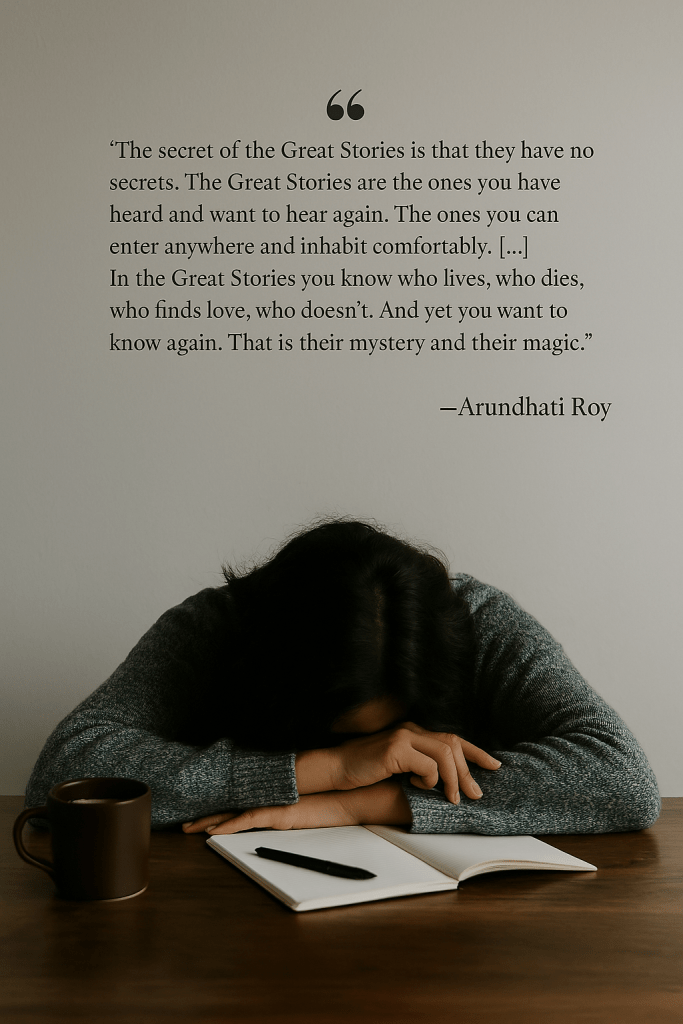
[Representative Image generated using AI]
When I first started writing the novel (note: it was still called The Novel back then), I did what any self-respecting, under-confident writer does: I collected quotes.
Not just any quotes, writer quotes.
The kind that sound like truth.
The kind you pin to vision boards and casually drop into conversations like you’re someone who journals in ink.
One quote, in particular, became my guiding principle. It read:
“The secret of the Great Stories is that they have no secrets. The Great Stories are the ones you have heard and want to hear again. The ones you can enter anywhere and inhabit comfortably. They don’t deceive you with thrills and trick endings. They don’t surprise you with the unforeseen. They are as familiar as the house you live in. Or the smell of your lover’s skin. You know how they end, yet you listen as though you don’t. In the way that although you know that one day you will die, you live as though you won’t. In the Great Stories you know who lives, who dies, who finds love, who doesn’t. And yet you want to know again. That is their mystery and their magic.”
I printed it. I underlined it. I believed in it so deeply that I briefly forgot it was Arundhati Roy who wrote it and not me. Which, to be fair, is probably the most sincere form of literary admiration, confusing someone else’s brilliance for your own internal compass.
Anyway. I had the quote. I had the vibe. I had the voice.
What I did not have was a plot.
But I reassured myself that my story was simple. Familiar. One of those Great Stories she wrote about. Surely I didn’t need plot twists or dramatic third-act reveals. I just needed to start writing.
Still, some part of me, probably the same part that watches productivity reels at 2 am, felt I should respect structure. Or at least pretend to.
Enter Freytag’s Pyramid.
The classic five-part structure: exposition, rising action, climax, falling action, and some good ole resolution. It sounded manageable, like IKEA instructions for feelings. I printed out a graphic. I gave each act a working title. I even opened a Notion page called “Plot Beats – DO NOT PANIC.”
I began with exposition.
And now, 30,000 words in, that’s where I still am.
The characters have been introduced. There are beautifully meandering inner monologues. Entire scenes set in ancestral kitchens. A minor subplot involving a childhood friend and unspoken regret. At least four food metaphors.
The conflict? Still under construction.
There are moments that feel like they might be building toward something. A broken hairclip. An ignored voice note. A half-finished Google search. But nothing actually happens. There are gestures toward rising action, but nothing ever rises. It all just simmers.
Every time I try to write a turning point, it feels forced. Like I’m interrupting the novel’s natural rhythm with… ambition. The mood feels disturbed. The characters start sulking. Amma walks out of the kitchen and refuses to re-enter the scene.
And so, I circle back to what’s safe. To exposition. To fragments of memory and dialogue that loop, recur, and refuse to lead anywhere specific. Because while structure demands progress, I seem to have built a story that prefers to sit in one spot and ruminate.
There are no arcs. Just circles.
No turning points. Just lingering questions.
No climax. Just a gently building sense of déjà vu and digestive discomfort.
And this, I suspect, is why structure feels like a scam. Not because it’s wrong, but because it assumes the writer knows what they’re doing. That they’ve mapped out the road, placed the milestones, packed snacks for the journey.
Meanwhile, I’m the kind of writer who walks into a scene and forgets what day it is. Who introduces a new character in Chapter 14 just to see what happens. Who can spend 600 words describing a cupboard but forgets to mention that the main character is married.
So yes, I’ve read the craft books. I’ve printed the pyramids. I’ve highlighted the “Save the Cat” beat sheet like it’s scripture.
But none of it has helped me escape exposition.
Anyway, I often tell my future imaginary readers:
Out beyond ideas of exposition and falling action, there is kinda sorta maybe a novel.
And I’ll meet you there.
Wait, did Rumi say this?
Let’s just assume I did.
And that, dear readers, is reason no. 127862820 for how not to write a novel.

 Primalsoup
Leave a comment