
Or, how I wrote 2,000 words, submitted to 18 journals, and got rejected by 17 (the 18th ghosted me)
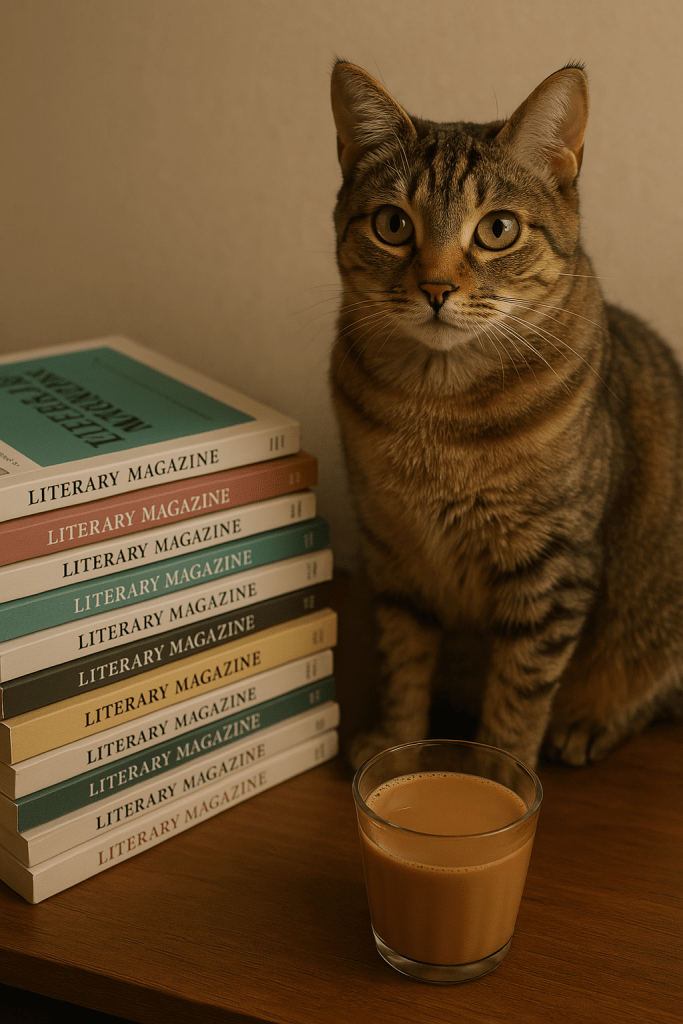
[Representative Image generated using AI]
When you’re not writing your novel but still need to prove to yourself (and a few persistent relatives) that you’re a real writer, there’s one thing left to do: submit a short story.
It starts innocently enough. You polish that one piece that feels like it’s “ready.” You give it a title that’s vague-but-deep. You add an epigraph that feels profound. You imagine someone at The Paris Review reading it and pausing thoughtfully, hand over heart.
It will, of course, be published. You will, of course, be discovered. The literary world will be changed.
Cut to: a Submittable dashboard full of blue “In Progress” buttons and quiet despair.
The Five Stages of Literary Journal Rejection
- Delusion
“This story is Granta-worthy.”
You visualise the email with “Congratulations” in the subject line. You practice your lit fest panel smile. - Spreadsheeting
You make a submission tracker. Colour-coded. With tabs. You add columns like “Response time,” “Vibe,” “Payment,” and “Likelihood they’ll accept someone from my timezone.” - Ugh, the Fees
Some journals want you to pay to submit.
And don’t even pay you if accepted.
You feel morally indignant for about five minutes. - The Cultural Connection Spiral
You begin to seek out journals that sound familiar.
The Bombay Review. Bangalore Lit Quarterly. Madras Ink.
You tell yourself it’s about representation. But really, it’s just about increasing your odds. - Tiny Victories, Big Feelings
You get a reply. It starts with “We are pleased…”
And suddenly, that obscure journal with a six-person readership becomes your new literary home.
The Venn Diagram of Literary Journals (Drawn in Desperation)
At first, you tell yourself you’ll only submit to journals that:
- Don’t charge
- Do pay
- Respond in under 3 months
- Are known outside of one niche Reddit thread
This Venn diagram contains zero journals.
So you redraw it. Again and again. Eventually, you’re submitting to:
Journals that charge you a fee
But also pay you if you’re accepted
Or at least offer a free PDF and a Twitter shoutout
Then:
Journals that don’t pay, but don’t charge either
The literary equivalent of exposure therapy
And finally:
Journals that charge you to submit
And still say, “We cannot offer payment at this time.”
What?!
Rejection, But Make It Monetisable
After the polite rejection, some journals don’t just leave you alone.
No. They send follow-up emails.
“Thank you for your submission. Unfortunately, we’re unable to publish your work at this time. But we loved your voice!”
Cue hope.
And then:
“You might enjoy our upcoming fiction workshop with [well-known-ish author], only $2,000 for a six-week virtual course!”
I beg your pardon?
You’ve just rejected my work and now you want me to pay you so I can learn to write better?
What kind of writer has $2,000 lying around?
Certainly not the kind who’s been ghosted by four magazines and offered “exposure” by a fifth.
And yet.
You consider it.
You click. You check the syllabus. You wonder if this is the workshop that will unlock your real voice.
Then you close the tab.
And open Submittable again.
The Rejection Taxonomy
Not all rejections are created equal. Some are blunt-force trauma. Others are confusingly hopeful. Here’s how they show up in your inbox and how you process them in your spiral:
1. The Form Rejection
“Thank you for your submission. Unfortunately, we are unable to include your work at this time. We wish you the best in placing it elsewhere.”
You: Did they even read it?
Your brain: Probably not.
Your heart: They hated it.
Your Submittable status: “Declined.”
This is the literary equivalent of being ghosted after a job interview.
2. The Kind But Generic No
“Thank you for sending us your story. While we appreciated the chance to read it, we felt it wasn’t the right fit at this time.”
It sounds gentler, but it’s still a no.
You squint at the wording, obsessing over “we felt” — maybe it sparked debate in the editorial room?
It didn’t.
But wait, did they say “at this time”?
That means… in another time, in another timeline, this might have worked.
If Mercury hadn’t been in retrograde. If you’d submitted one day earlier. If you’d swapped paragraph three and four.
You spiral.
You are now defeated by physics, not prose.
3. The Semi-Personalised Rejection
“This one came close. We enjoyed the voice and the emotional tone, but ultimately it wasn’t quite there for us.”
You screenshot it. You send it to three friends.
You reread it four times looking for secret praise.
You start believing “almost” is a literary achievement.
4. The Actual Personal Note
“We really admired this story. The ending especially stayed with us. We hope you’ll consider sending more work in the future.”
You don’t breathe for six minutes.
You consider replying. You begin plotting your next submission. You check if the editor follows you on Instagram. They don’t.
But still — they saw you.
And that’s enough to ruin your week in a hopeful way.
The Literary Contest Gateway Drug
Before you know it, you’re entering contests.
Because contests are how real writers are discovered. Obviously.
You read bios that say: Winner of the 2021 Fiction Prize from That One Journal You Pretend to Know But Can’t Pronounce.
You think: This will be me.
You pay the $25 entry fee. You label the story “Final_Final_ForContest.”
It doesn’t place.
Someone on Twitter announces their win. They’re 22. It’s their first submission. You consider quitting entirely.
Then you see the next contest deadline.
You enter again. With a different story.
Slightly reworked. Same delusion.
Granta Dreams, Madras Loyalty
When I first started submitting, I thought my story was meant for the big leagues.
The Paris Review. Granta. Something ending in “Quarterly” with impeccable kerning.
Then I discovered a set of small-but-mighty journals, ones with names I’d grown up with.
And while it’s not foolproof, I will say this:
A journal with Madras in the name accepted my story.
Bombay and Bangalore, I’m still waiting on.
Which is why, no matter what anyone says, Madras will always be my favourite city.
Literary Success, Redefined
You start with literary superstardom in mind.
You end with a rejection that’s just warm enough to make you cry.
You start with The Paris Review. You land in a zine called Seagull on Fire that publishes on Google Docs.
But it’s something.
The story exists. It was read. And someone, somewhere, said:
“We are pleased.”
And that, dear readers, is reason no. 127862819 for how not to write a novel, because you were too busy chasing literary validation one 2,000-word story at a time.

 Primalsoup
Leave a comment