
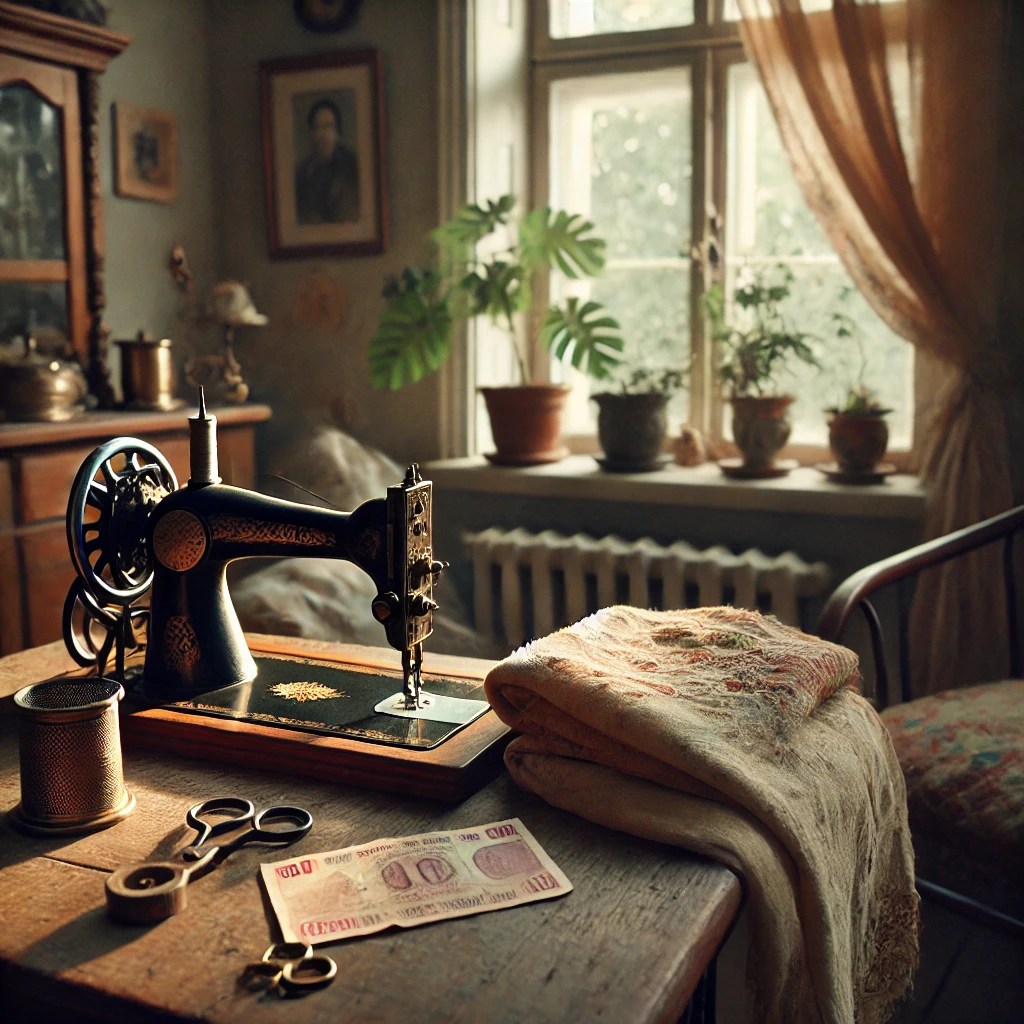
[Representative Image generated using AI]
It was Amma who taught me the art of creating surprise money. Between managing an old, crumbling house, an often absent and unemployed husband, three children born a year apart, and two aging parents, this was one of the few joys Amma allowed herself. It was a small game she played, mostly with herself—a secret delight against the constant press of scarcity.
Amma was meticulous with money. She worked two jobs: one as a mathematics teacher at a modest school down the road, the other as a blouse-maker in a small shop nestled in the crowded lanes of Fashion Street.
“Teachers are at the bottom of the pyramid in any food chain,” Amma would often say, her tone a mix of resignation and practicality.
The school where Amma taught, Amina Public School, had the air of something temporary, a patchwork existence like many things in our part of the world. There were whispers that it had been a front for dubious activities, or even that it had communist roots. But none of this mattered to Amma. The school, with its modest salary, paid our bills. When I once asked her who Amina was, she answered curtly, “Amina pays for your food, your clothes, your school fees. That’s all you need to know.” Amma had no patience for idle questions—there was always work to be done.
Her second job, at Madhuri Dressmakers, was the more glamorous one. Named after the Bollywood icon Madhuri Dixit, the shop specialized in tailored clothes for women in the busy lanes of Bapu Bazaar. The shop owner, Munir, was an eccentric man with a love for Hindi cinema and fashion. He ran the store with an almost religious devotion, and Amma worked there from late afternoon until late evening, earning six thousand rupees a month. It was with this money that she played her little game of surprise money.
The idea of hiding money started after a particularly tough month at Madhuri Dressmakers. Diwali orders had poured in, and Amma had worked tirelessly, earning an unexpected bonus of three thousand rupees. On her way home one evening, as she walked the dark alley between the bus stop and our house, she was followed by a group of teenage boys. They made lewd comments, and although she ignored them, one of them went too far, touching her inappropriately. Amma, in her usual no-nonsense way, twisted his arm in self-defense, but they knocked her down and ran off with her bag. Inside the bag was the money she had worked so hard for.
That night, as Amma sat quietly nursing her bruises, she decided she would never keep all her money in one place again. From then on, she began hiding small amounts of money in different places around the house—inside books, under mattresses, in old tin boxes. Sometimes it was just a rupee or two, other times a five or ten-rupee note. It became a game, one she encouraged us to play as well. Whoever found the money got to keep it, hence the name: Finders, Keepers.
By the time I turned twenty-seven, I had been away from home for six years, and everything felt different when I returned. The house was even more fragile, and my father, whom we called Abba, had long since left us for good. Amma, to my surprise, had remarried Munir, the owner of Madhuri Dressmakers. My sisters seemed to accept this new reality easily, but I struggled with it.
Abba had been distant, more of a figure in the background than an active presence in our lives, but at least he was our father. Munir, with his garish kurta-pajama, brown teeth from chewing too much paan, and gaudy gold chains, felt like an unwelcome intruder. I couldn’t understand why Amma, after all she had endured, would choose to marry someone like him.
But something had changed in Amma in the years since Abba left. There was a quiet peace about her now, a softness I hadn’t seen before. Though Munir was loud and brash, Amma seemed to tolerate him with a patience that I couldn’t quite comprehend. She would laugh at his silly jokes and sit with him after work, sipping chai in companionable silence.
One evening, after dinner, I asked her about it. “Why Munir?” I couldn’t keep the frustration out of my voice.
Amma looked at me, her eyes calm and steady. “Peace, beta,” she said simply. “I was tired of fighting.”
Her words stayed with me. In the years of my childhood, I had watched Amma struggle endlessly—with Abba, with work, with the demands of raising three children on her own. Perhaps Munir, with all his flaws, had given her the one thing she had always needed: rest.
Amma passed away the following winter. We held the traditional chaliswan on the fortieth day after her death, and the house was filled with relatives and neighbors. After the prayers were over and the guests had left, Munir and I sat in the quiet living room, the weight of Amma’s absence heavy between us.
It was then that I began to notice the small things Munir did—things that reminded me of Amma. He watered the plants she had tended to for years, arranged her sewing materials as she had left them, and sat at her sewing machine, running his fingers over the fabric she had once worked on.
One day, while packing Amma’s things, we found a small, old leather pouch at the back of her closet. Inside was a crumpled fifty-rupee note and a small brass key. Munir smiled softly as he held it up. “She always had her little secrets.”
The key unlocked a wooden trunk, one I hadn’t thought of in years. Inside were Amma’s treasures: old photographs, letters, and fabric—bright, colorful swatches she had collected over the years. There was one piece in particular, a deep purple cloth with golden thread running through it. Munir lifted it gently, his face softening as he remembered. “She said it reminded her of the night sky.”
I had seen that fabric before. Amma had shown it to me once, long ago, saying she would make herself a blouse from it. But life had gotten in the way, and the fabric had been tucked away, forgotten. Seeing it now, in Munir’s hands, I realized that Amma had found something in him that I had missed. He may not have been Abba, but he had loved her in his own way.
In the weeks that followed, I slowly began to make peace with Munir. He wasn’t perfect, but neither had Abba been. And in the quiet moments after Amma’s death, I saw how much he had cared for her, how much he still missed her.
On the last day I spent in the house, Munir and I sat together one final time. He pulled a crumpled ten-rupee note from his pocket, one of Amma’s last hidden treasures that we had found under the mattress. “She always knew how to surprise me,” he said, smiling through his sadness.
As I looked at the note, I realized that Amma’s game of surprise money had been more than just a way to hide her earnings. It had been her way of leaving small pieces of herself behind for us to find, long after she was gone.
In the end, Amma saw Munir as her one big love. Munir, and not Abba. And I think I saw why now, as I sat with him in my childhood home. The house, though emptier now, was still filled with her presence. Every crumpled note, every hidden coin, was a reminder of the love she had stitched into the fabric of our lives.

 Primalsoup
Leave a comment