
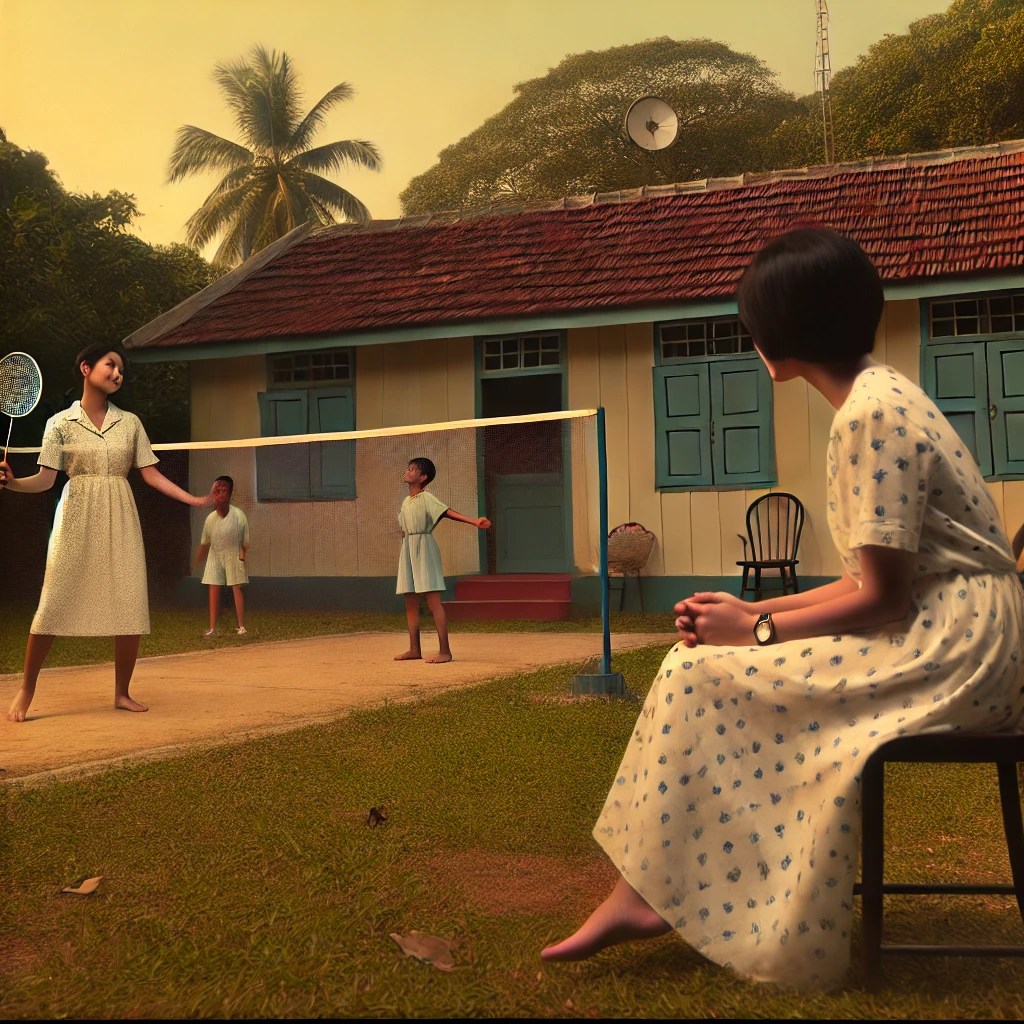
[Representative Image generated using AI]
Why does one feel friendlier and more social when visiting another city? Maybe it’s the thought of yet another room service dinner of rice and yellow dal, or perhaps it’s the loneliness of hotel rooms creeping in, making everything feel a little unsafe. You start longing for familiarity—who better to turn to than old friends? There’s a safety in nostalgia, a comfort that’s hard to find elsewhere.
On a recent trip, I met up with an old colony friend—Rinku.
Rinku and I were never particularly close. She was three years older than me, and at thirteen, that gap felt like a lifetime. More importantly, she was in a different house at school—one I disliked with the irrational passion only teenagers possess.
But our families were connected, so I always knew what was happening in her life. To me, Rinku was the girl who made all the choices my mom wished I had made but didn’t. Eventually, I lost touch with her, deliberately.
Yet, after a few phone calls and four years later, we found ourselves sitting together, surprisingly happy to reconnect. Suddenly, she wasn’t the older didi who had everything figured out. She was fallible, like anyone else, and strangely, that was reassuring. I found myself warming to her.
We talked about everything—badminton games, potluck dinners, colony parties, boys, and of course, gossip. We discovered that we disliked the same people for the exact same reasons, a realization that creates a strong bond. We had more in common than I’d thought: our confused, often bizarre relationships with men, our shared feeling of being misunderstood, and our misplaced urge to blurt out every thought that crossed our minds.
Strangely, we had both lost a parent around the same time. In both cases, it was after a prolonged illness that had drained our families.
News of B Auntie’s death—Rinku’s mom—came as a bit of a shock. I hadn’t heard through the department grapevine and guiltily wondered if I’d conveniently forgotten. But worse than not knowing was not knowing what to say. When people first met me after my dad’s death, they always said something. Sometimes thoughtful, sometimes touching, sometimes painfully awkward—but always something. A small shared memory.
Most people would tell me about my dad’s gentleness, his warmth, the long, painstaking letters he’d write, his beautiful handwriting, his absent-mindedness, his love for quoting Ghalib and Faiz completely out of context, or his rendition of some Talat Mahmood song. You’ve heard it all a million times, but you still want to be told. Because you want to remember him alive.
But here I was, completely lost about what to say about B Auntie. I mumbled something inane, and we parted ways.
Back in my hotel room, I wanted to kick myself. Sometimes, the things we don’t say are the ones we regret the most. B Auntie and I had shared a quiet bond after all.
In our colony, every family had a nickname. There were the usual ones along regional lines—Bengalis, Oriyas, Sardars, Malayalis—but it wasn’t about stereotypes, at least not that I noticed as a child. Our colony was close-knit, despite being a melting pot of different regions. We were all from the same department, which made for a cohesive unit. Annoying celebratory events and parties were the center of our collective existence.
Rinku’s family moved into the colony about a year after we did. It was a typical cantonment colony, where socializing was formal and well-planned. New families meant welcome parties—breakfast at Colonel R’s, lunch at Mrs. T’s, and dinner at Maj Gen V’s. Even the menus were pre-decided. “We’re making stuffed capsicum, so you stuff something else,” the aunties would coo into the phone.
Invitations were sent to Rinku’s family, as we aimed to overwhelm them with our hospitality. But B Auntie didn’t show up to any of the events.
Is she offended? Is she unwell? People speculated. Uncle would apologize softly, “She doesn’t like going out much. Please don’t mind.”
The colony was scandalized. Does she have a contagious illness? Are they divorced? Is she his second wife? The connections people drew between these theories and attending lunch remain a mystery to me, both then and now.
But we kids were fascinated. Who was this mysterious B Auntie?
Weeks turned into months, and people ran out of excuses for her. She was polite enough if you visited—serving chai and Parle G biscuits (the only ones available at the canteen)—but she never returned the visits or involved herself in colony activities. Eventually, people lost interest in wooing her.
One of the biggest exceptions people took to B Auntie was her unwavering dedication to wearing a nightie—all day, every day. The long, shapeless garment that most women wear to bed? She wore it everywhere.
Now, a nightie is a fantastic piece of clothing: comfortable for sleep, perfect for cooking, and suited to tropical climates. But in our colony, it was considered “modern,” which didn’t sit well with the aunties who still practiced ghunghat in front of their in-laws. My mom, for instance, hated the sight of a nightie after 7 a.m. To her, it symbolized laziness and a refusal to take on the world.
Despite her fascination with B Auntie, my mom couldn’t get past the nightie. But I was intrigued. My friend K and I played badminton near B Auntie’s house, and she would sit outside with her chai, watching us, always in her nightie. Eventually, she became our unofficial umpire. If she said it was out, it was out. Despite our initial reservations, we grew fond of her. She knew the game, and she listened to our girlie conversations. And when we learned she had gone to boarding school, she became our hero.
When K’s family moved away, I was devastated. I had to play with the younger boys, which neither of us enjoyed. Playing with the boys meant no more badminton, and therefore no more B Auntie. Then one day, while I was heading toward the boys to play Pithoo (a game I vaguely recall), B Auntie, in her white-flowered nightie, said, “I’ll play with you.”
And to the amazement of everyone, including a few passing aunties, B Auntie showed us why she had represented her state in badminton.
Looking back, she was a fascinating woman—silently rebellious and entirely comfortable in her own skin (or nightie). I’m glad I got to remember her, even if I didn’t say the right thing at the time.
May she rest in power.

 Primalsoup
Leave a comment