
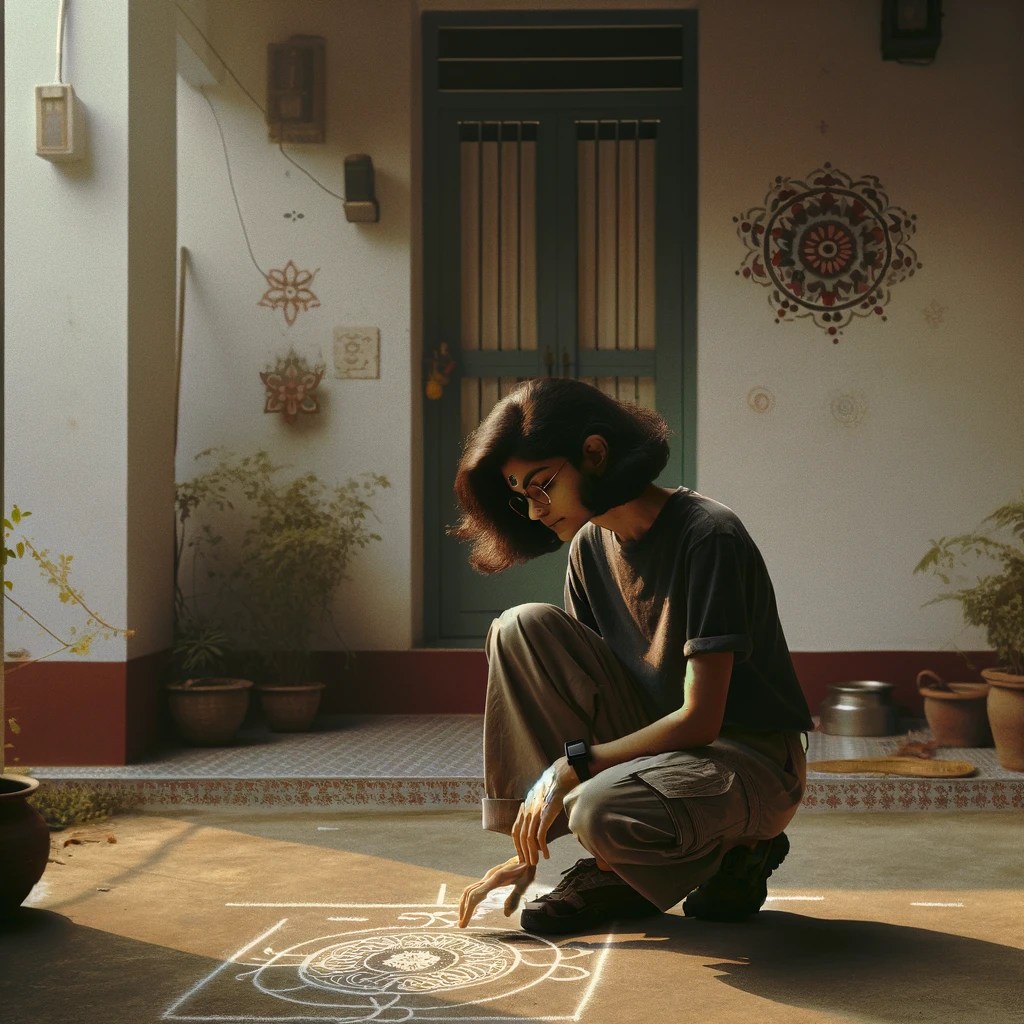
[Representative Image generated using AI]
Some years back, I read Ameen Merchant’s “The Silent Raga.” Its premise piqued my curiosity, drawing me in because of its resonance with my cultural context. You see, I used to be unabashedly parochial at one point (because I was young and stupid, I suppose). I was the type who would send SMS votes to “save” reality TV contestants hailing from my corner of the world. Shudder, I know!
Anyhow, back to the book in question. At the outset of the book, a vivid description unfolded of the protagonist creating a kolam—a design woven from dots, squiggles, flowers, and intersecting lines, a traditional welcome mat to her world. The mere mention of this intricate ritual, one I had witnessed throughout my life, captured my attention. Drawing a kolam had evolved from an art into a daily ritual. Each morning, the remnants of the previous day’s design were swept away, and a fresh pattern was crafted. “Come into my home,” it implored, until the newspaper vendor carelessly would hurl the paper onto your morning labor of love.
My mother had been crafting kolams for as long as I could recall. Over the years, their size, complexity, and the number of dots diminished, yet the kolam endured. The more intricate ones were reserved for special occasions and occasional Fridays. My mother never pressed me to learn this art. When I moved into a house in Bombay, she offered a sticker kolam. “Please paste it outside your home,” she suggested. I didn’t use it until I found myself living alone. Not that my roommates would have minded, but I hesitated to impose my morning welcome on them. When I returned to Madras, I discovered that my mother’s kolam tradition persisted, and it dawned on me that I wanted to learn this art. My mother was delighted to teach me.
Drawing kolams proved more challenging than I’d imagined. There’s a technique to holding the kolapodi just right, ensuring the lines are unbroken and even. It requires a grasp of basic mathematics, an understanding of space and symmetry, and the ability to conjure something different each day. It should not be so artistic that neighbors inquire if it’s a special occasion, nor so minimal that the guest feels unappreciated. Once created, it must be protected for as long as possible. My grandmother used to tell me that each kolam was a metaphor, a message about the home and the woman’s state of mind that day.
And now, the book – here’s an excerpt that resonated with me:
“With the bucket of water in one hand, I would seize the broom and the kolapodi tin with the other, making my way to the front of the house. I’d sweep up the dried leaves and dust from the path leading to the front door, gather them neatly into the pan, and then empty it into the big, rusty metal bin beside the gate. Next, I’d sprinkle the ground with fresh, cold water from my cupped palm, smoothing it out.
The kolam I designed depended on my feelings that particular day. On some mornings, it was an elaborate welcome to the dawn, ambitious and brimming with sinuous grandeur. My hands would weave a tapestry of blooming flowers and intertwined stars. I’d take handfuls of kolapodi – one, two, three, even four sometimes – and pour my heart into my masterpiece, a sublime welcome mat for the sun. Yet on other days, it was a hurried note of dots and curves – a brisk, perfunctory kiss of cordiality – fashioned with just half the usual amount of powder.
For many years now, I haven’t dipped my hands into kolapodi. I can’t say I miss the grainy sensation of powdered rice and white rock on my fingertips.
I am no longer a prisoner to patterns.”
In these lines, the writer deftly juxtaposed the banality of crafting patterns with a life-altering decision made by the protagonist, creating a resonance between the mundane and the profound.
After I lost my mother, I relocated to Bangalore, where I found myself bereft of anyone to craft perfunctory or elaborate welcome mats for my home. The skill remained unmastered, a longing unfulfilled. On special occasions, my sister-in-law, an expert in the art, would arrive with a small bowl of liquid white, fashioning a kolam for me. Neighbours, Amazon delivery personnel, and visitors would marvel at its intricacy. I chose not to reveal that I hadn’t created it myself, accepting their compliments with a quiet gratitude.
In those moments, I found solace in the perpetuation of tradition—a thread that bound me to the past, a sanctuary of shared memories. However, as I reflected upon my life, I realized that to truly escape the confines of this pattern, I needed to master this skill myself. Yet, until that happens, I am going to use the loophole Amma gave me many years ago – the kolam sticker, a reminder that the art of kolam-making need not be a prison but rather a bridge to cherished memories and the promise of a future and where I am not piggybacking on someone else’s talent.

 Primalsoup
Leave a comment